

February 2026
New horizons.
There isn’t a more fitting name for the Winter 2025 issue of Alger Magazine. Between an entirely new editorial staff, and welcoming a new group of writers, the first semester of the 2025-26 school year was a challenge in itself.
But from every change comes growth. Growing into new positions, adjusting to the shift from writer to editor, and as always, becoming more comfortable speaking on controversial topics. These are the horizons that Alger faced head on while working to produce the product you read today, and we could not be more proud of each and every author.
Ranging from Southeast Asia to Central Africa, our writers this semester have jumped headfirst into challenging, research-heavy topics with the eagerness to learn, write, and keep learning. They asked difficult questions, found nuanced sources, and ultimately wrote stories that not only reflect the shifting landscapes of the globe, all while bearing the responsibility of reporting on said issues.
To our writers: thank you for stepping up and speaking out, even when it seemed too difficult. Your work has not gone unnoticed, and we appreciate not only your efforts, but your patience.
New horizons is more than a statement about the current state of global affairs. It represents the transitions, resilience, and the promise of what Alger Magazine is becoming.
Sincerely,
Alger Editorial Staff
From Australia to Vanuatu: The Pacific Islands Forum and Its Impacts on the World Stage
Audrey Coleman, Managing Editor
When people think of global organizations, the first ones to come to mind include the United Nations (UN), the World Health Organization (WHO), the World Bank, and potentially others like the European Union (EU) or the African Union (AU). Yet at the same time, hundreds of other institutions are ignored, disregarded, and flat-out forgotten about, regardless of their impact on global discussions and initiatives.
One of those groups often pushed to the side is the Pacific Islands Forum (PIF). The PIF is a coalition of 18 countries, notably Australia, Fiji, New Zealand, and Samoa, that focuses on bringing the region together in collaboration, working towards shared goals like sustainability, people-centered development, and economic growth.1 Although the forum rarely steps into the global spotlight, its role has become increasingly significant as international attention shifts toward the Pacific region.
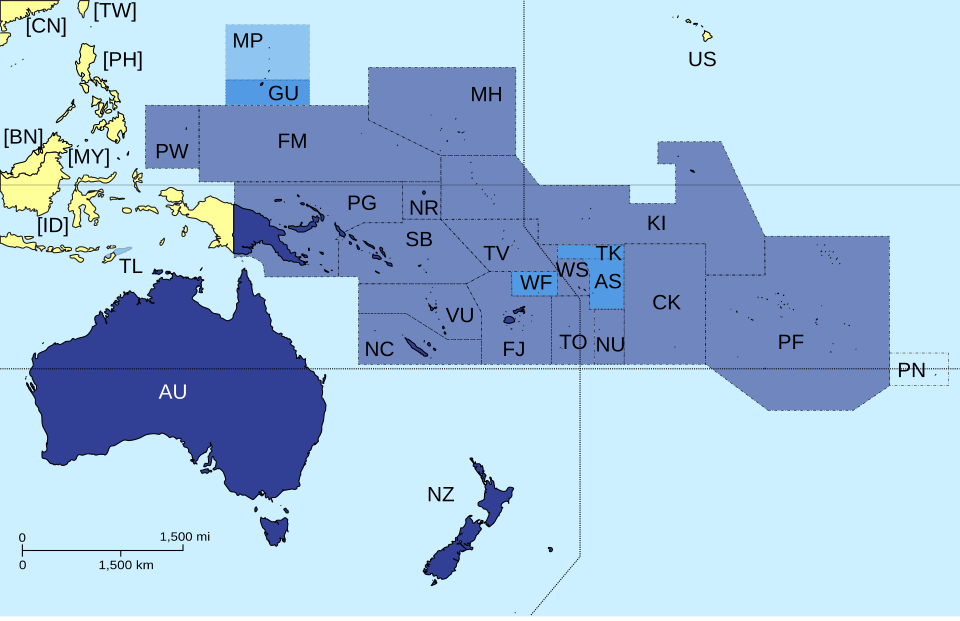
The dark blue portions of the map signify member countries of the Pacific Islands Forum. Pacific Islands Forum Membership Map. Image. Wikipedia.
Some of the organization’s specific goals, just recently put in place at the most recent summit in September, include the revitalization of the Pacific Leaders Gender Equality Declaration,2 the creation of the “#MyBluePacific2050” Youth Ambassadors program,3 and agreeing that a review of the regional architecture is required.4
The forum was created in 1971, after smaller Pacific nations decided they should be the ones making the decisions about their regions, not colonial powers like the United States, France, and the United Kingdom.5 While this theme has backed away from the foreground of the forum’s purpose, participating nations are still very clear when it comes to establishing power boundaries between themselves and world powers, namely the United States and China. This emphasis on regional autonomy continues to shape how the PIF navigates international partnerships, though some relationships have been up for debate.
The plans and impacts of PIF find themselves being swept under the rug, especially in larger global conversations where its policies are rarely mentioned at all. What people fail to understand is the impact that these policies could have on the world stage, specifically how the partnership between PIF and countries like the United States and China could create a much larger scene than what people typically assume. Though often overlooked, the Pacific Islands sit at the center of the world’s next major geopolitical arena. With vast ocean territories, strategically critical shipping lanes, and some of the earliest, noticeable, and severe climate impacts on the planet, the region has gained new critical importance. As a result, the PIF has become a space where large powers — especially the United States and China — attempt to build influence, often in ways that complicate the forum’s original mission of decision-making by the Pacific, for the Pacific.
As global attention toward the Pacific has increased, the PIF has been forced to navigate webs of external interests while attempting to preserve the principles it was founded on. What once was viewed primarily as a body designed for regional development, the PIF now operates within a space shaped by strategy-based competition, climate diplomacy, and security concerns. The Pacific’s vast maritime territory, with PIF countries occupying 20% of the world’s Exclusive Economic Zones (EEZs),6 combined with its central role in global shipping routes and fisheries management, has drastically increased the region’s strategic value. Within that 20% of EEZ, over 28.5 million Twenty-foot Equivalent Units (TEUs) were transported transpacifically in 2024,7 and the Western and Central areas of the Pacific Ocean provide over 50% of the world’s tuna supply, equaling over $5 billion USD.8

A photo of the PIF leaders at the 2025 Summit. 2025 Pacific Islands Forum Leaders. 2025. Photograph. Pacific Islands Forum.
At the same time, Pacific Island nations have leveraged their shared vulnerability to climate change to assert moral and political authority in international negotiations. These dynamics have elevated the forum’s profile while simultaneously complicating its mission, as increased global engagement brings both opportunity and external pressure. As is usually the case, there are two frontrunners in the race to get entrenched in the Pacific, with the obvious answers being the main offenders: the United States and China.
Both China and the United States became official dialogue partners of PIF in 1989. A dialogue partner is a country “that strategically engages with the Pacific Islands Forum, contributing to discussions and initiatives aimed at regional development and security.”9 Usually, the participation of dialogue partners is welcomed, albeit more watched, given the reasoning behind founding the forum. But in 2025, the Solomon Islands decided no external voices would be present at the annual summit, excluding countries like China, the United States, and Taiwan.10 The decision came amid rising tensions between China, an established dialogue member, and Taiwan, one of the forum’s development partners. A development partner is a country that agrees “on the importance of coordinating better their national and regional level initiatives to strengthen democratic institutions and good governance in the Pacific.”11 Taiwan has been a development partner since 1992; however, recent tensions between China and Taiwan have found their way into forum decisions.12
The Solomon Islands’ decision in 2025 to exclude external actors from the annual PIF summit revealed deeper fractures within the region regarding foreign engagement. Some summit member states view dialogue and development partnerships as essential sources of economic assistance and international leverage, most notably the Solomon Islands, based on recent patterns. However, others worry that increasing dependence on outside powers threatens Pacific sovereignty. Smaller nations, like Papua New Guinea, believe that traditional partners (China, the U.S., and France) should assist with security.13 These concerns are particularly pronounced when external rivalries, such as the ongoing tension between China and Taiwan, begin to influence regional decision-making processes.
China has actively sought to expand diplomatic recognition in the Pacific, encouraging nations to sever ties with Taiwan in exchange for infrastructure investment and development aid. From 2019 to 2026, Taiwan’s Pacific Islands partnerships went from six to three, with the most recent switch being Nauru in January 2024.14 Meanwhile, Taiwan has maintained relationships with its remaining allies through medical assistance, agricultural programs, and educational exchanges, which include the Marshall Islands, Palau, and Tuvalu.15 These competing strategies have drawn PIF members into broader geopolitical disputes that have roots far outside the region’s borders. The decision to limit outside participation at the 2025 summit reflected a collective attempt to prevent the forum from becoming a stage for other nations’ arguments rather than a platform for Pacific goals and priorities.
The PIF has its impacts on world powers, namely the United States and China. While the U.S. became a dialogue partner in 1989, the last two presidential administrations put much more of an emphasis on building a relationship with the organization. The Biden-Harris Administration (2020 - 2024) hosted two PIF summits at the White House, opened new embassies, and worked with Congress to provide over $8 billion in new funding.16 Working with smaller nations seems mildly out of character for such a large country, but the U.S. benefits from this kind of pairing.
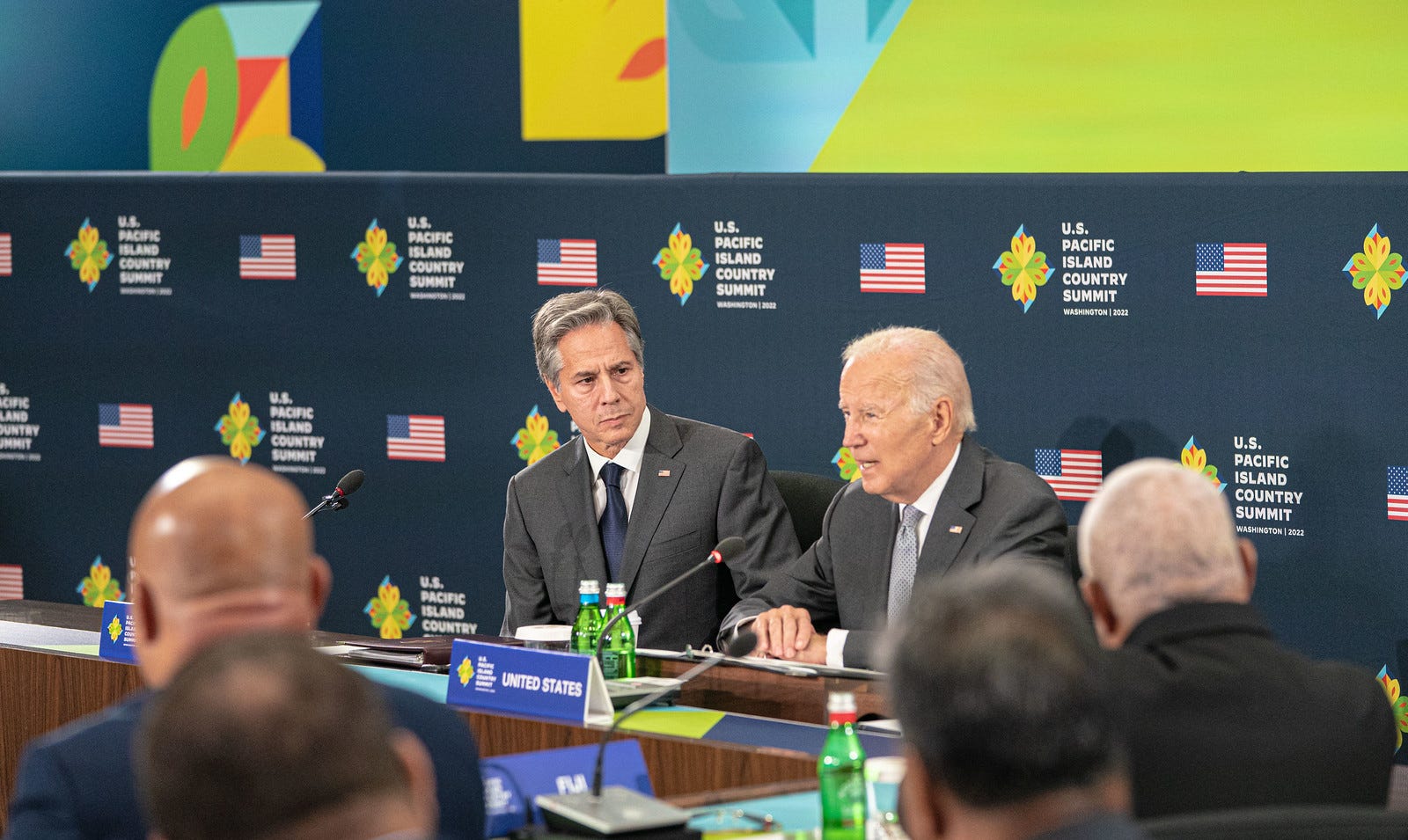
A photo of former President Joe Biden at the 2022 U.S. Pacific Island Country Summit. President Joe Biden Speaking at 2022 Summit. 2022. Photograph. U.S. Department of State.
By working with the PIF, the U.S. gains a deeper understanding of climate change, the importance of implementing sustainable policies, and overall, widening our scope on how the rest of the world is reacting to the changing climate. Pacific Islanders are facing the challenge of relocation due to rising sea levels, floods, and storms affecting their homes,17 whereas Americans are witnessing more extreme weather shifts, rising temperatures, and irregular rain cycles.18
On the economic side, the pairing of PIF and the U.S. is leading to a stronger material benefit, namely in the fishery business. A $60 million project investing in Pacific Islands Fisheries associated with the South Pacific Tuna Treaty, which allows U.S.-flagged vessels to fish in the exclusive economic zones of 16 Pacific Islands countries.19 Not only does this invigorate the relationship between the U.S. and members of the PIF, but it also generates a substantial gross revenue for both parties involved.
Beyond fisheries cooperation, U.S. engagement with the PIF has expanded into climate resilience, infrastructure development, and digital connectivity. American funding has supported disaster preparedness programs, with the United States Agency for International Development providing over $3.6 million in 2024 to Pacific nations’ disaster preparations.20 There have also been renewable energy initiatives, with the Department of State giving $1 million to support Tuvalu’s sustainability goals.21 The construction of undersea cable systems to improve internet access across remote islands has also been a project, with the United States collecting over $90 in donor funding as of August 2024.22 These plans address long-standing development challenges in the Pacific while reinforcing U.S. diplomatic presence in a region that has experienced decades of relative neglect.
This broader approach reflects a shift in U.S. foreign policy toward recognizing the Pacific Islands as valuable partners rather than peripheral voices. By aligning its investments with Pacific priorities — particularly climate adaptation and sustainable development — the United States has sought to frame its involvement as cooperative rather than coercive. However, this renewed engagement also blatantly benefits U.S. interests, including countering China’s expanding influence and strengthening U.S. positioning within the broader Indo-Pacific framework.
China’s motives behind working with the PIF aren’t as benevolent-appearing in comparison to the U.S. Historically speaking, China has become entangled with smaller, developing nations simply for its own gain, under false guises of wishing to help a neighbor in need. This can be backed by the Belt and Road Initiative, a global infrastructure initiative intended to invest in over 150 countries, with participating countries accounting for over 75% of the population.23 Members of PIF are no exception, with China contributing over 1 billion annually to PIF to “support the Pacific Trade and Invest China office to work with the private sector to develop, grow and promote business in the region by facilitating export opportunities with buyers and attracting foreign direct investments.”24 Beijing has steadily increased its presence in the region through infrastructure development, such as building roads, ports, airports, and other vital physical landmarks for economic success, as well as increased diplomatic outreach.25 These moves are positioning China as an alternative partner to traditional Western allies, reshaping regional power dynamics, and raising concerns among Pacific leaders about long-term dependency and political leverage. The shift is apparent in the Solomon Islands, and is becoming less shocking to see across other Pacific nations.
Beyond economic investment, China’s growing role in the Pacific has become increasingly extended into security and political cooperation. The 2022 security agreement between the Solomon Islands and China marked a significant turning point in regional perceptions of China’s intentions, raising concerns among Pacific leaders and traditional partners about the potential for future military access.26 While Chinese officials framed the agreement as a response to domestic unrest and a means of strengthening the capacity of local law enforcement, critics argued it signaled a willingness to project security influence into a region historically resistant to militarization, as backed by the secrecy behind the creation of the agreement, sparking responses from the PIF as a whole and public comments.27 The agreement intensified scrutiny of China’s engagement with the PIF, particularly as security cooperation risks undermining the forum’s emphasis on regional stability and collective decision-making.
Despite mounting concerns and recent actions taken by the PIF, Pacific Island nations are not passive actors in China’s regional strategy. Many governments pursue a policy of strategic hedging, engaging with China alongside the United States and larger PIF countries, such as Australia and New Zealand, to maximize economic and political benefits. This approach allows Pacific leaders to leverage competition between major powers while maintaining diplomatic flexibility. However, hedging also places strains on regional unity, as differing national priorities can complicate consensus-building within the PIF, most prominently the disputes over Taiwan and consistent tensions stemming from picking the United States or China. The challenge for the forum lies in managing these varied approaches without fragmenting its collective voice or allowing external competition to dominate its agenda.
Overall, the PIF occupies a unique and increasingly consequential position within global politics. Though often overshadowed by larger international institutions, the PIF serves as a critical platform for Pacific Island nations to assert regional autonomy, coordinate development strategies, as seen in the establishment of the Pacific Resilience Facility in September 2025,28 and engage with global powers on their own terms. As the Pacific becomes a focal point of geopolitical competition between the United States and China, the forum’s role has expanded from regional coordination to global mediation.
The challenge facing the PIF is not whether to engage with major powers, but how to do so without sacrificing its founding principles. Partnerships with the U.S. and China offer economic resources, security cooperation, and international visibility, yet they also risk importing external rivalries into Pacific governance. Ultimately, the future of the PIF will depend on its ability to preserve Pacific-led decision-making while navigating an increasingly contested global landscape. In doing so, the Pacific Islands Forum embodies the idea that even smaller regional organizations can exert meaningful influence on the world stage.
Bibliography
Bozzato, Fabrizio. “Contours of Influence: China’s Expanding Footprint in the Pacific Islands.” Sasakawa Peace Foundation. Last modified July 10, 2025. https://www.spf.org/iina/en/articles/fabrizio_bozzato_01.html#:~:text=Infrastructure%20and%20Diplomatic%20Engagement,-From%20the%20mid&text=Diplomatically%2C%20the%20PRC%20has%20made,reciprocal%20backing%20on%20international%20issues.
Chanlett-Avery, Emma. “A Credibility Test: Will the U.S. Stand by the Pacific Islands Region Amid Its Exclusion?” Asia Society. https://asiasociety.org/policy-institute/credibility-test-will-us-stand-pacific-islands-region-amid-its-exclusion.
“Climate change impacts.” National Oceanic and Atmospheric Association. https://www.noaa.gov/education/resource-collections/climate/climate-change-impacts.
“Containerized cargo flows on major container trade routes in 2024, by trade route.” Statista. Last modified 2024. https://www.statista.com/statistics/253988/estimated-containerized-cargo-flows-on-major-container-trade-routes/#:~:text=Nearly%2030%20million%20twenty%2Dfoot%20equivalent%20units%20(TEU),making%20Trans%2DPacific%20routes%20the%20largest%20shipping%20zone.
“Development partners to better coordinate democratic institutions initiatives.” Pacific Islands Forum. Last modified February 28, 2012. https://forumsec.org/publications/development-partners-better-coordinate-democratic-institutions-initiatives.
“FACT SHEET: Following Through on the U.S.-Pacific Islands Partnership 53rd Pacific Islands Forum (PIF) Leaders Meeting in Nuku’Alofa, Tonga August 26-30, 2024.” The White House. Last modified August 27, 2024. https://bidenwhitehouse.archives.gov/briefing-room/statements-releases/2024/08/27/fact-sheet-following-through-on-the-u-s-pacific-islands-partnership-53rd-pacific-islands-forum-pif-leaders-meeting-in-nukualofa-tonga-august-26-30-2024/.
“Fisheries.” Pacific Islands Forum. https://forumsec.org/fisheries.
Hammond, Joseph. “China’s Security Agreement with the Solomon Islands: Wider Implications for Geopolitics in the South Pacific.” Air University. Last modified November 15, 2023. https://www.airuniversity.af.edu/JIPA/Display/Article/3588465/chinas-security-agreement-with-the-solomon-islands-wider-implications-for-geopo/#:~:text=***,Islands%2C%20Palau%2C%20and%20Nauru.
Keen, Meg, and Alan Tidwell. “Geopolitics in the Pacific Islands: Playing for advantage.” Lowy Institute. Last modified January 31, 2024. https://www.lowyinstitute.org/publications/geopolitics-pacific-islands-playing-advantage.
Mamu, Moffat. “PRF Treaty Sealed.” Solomon Star. Last modified September 10, 2025. https://www.solomonstarnews.com/prf-treaty-sealed/.
Newton, Tess. “Pacific Islands Forum: What is it and why does it matter?” The Guardian. Last modified November 6, 2023. https://www.theguardian.com/world/2023/nov/07/pacific-islands-forum-what-is-it-and-why-does-it-matter.
Pacific Islands Forum Membership Map. Image. Wikipedia.
“Pacific Maritime Boundaries Dashboard.” Pacific Data Hub. https://pacificdata.org/dashboard/maritime-boundaries#:~:text=20%25,2023%20included%2020%25%20of%20women.
Parlevliet, Alayna. “Support Threefold: Taiwan’s Pacific Island Allies.” Center for Strategic & International Studies. Last modified July 17, 2024. https://www.csis.org/blogs/new-perspectives-asia/support-threefold-taiwans-pacific-island-allies#:~:text=Three%20of%20Taiwan’s%2012%20remaining,have%20official%20relations%20with%20Beijing.
“Partnerships.” Pacific Islands Forum. https://forumsec.org/partnerships.
Pei-ju, Teng. “Pacific Islands Forum says Taiwan’s engagement status remains unchanged.” Focus Taiwan. Last modified September 13, 2025. https://focustaiwan.tw/politics/202509130015#:~:text=According%20to%20MOFA%2C%20Taiwan’s%20status,held%20alongside%20the%20annual%20summit.
“People’s Republic of China provides annual development cooperation funding to Pacific Islands Forum Secretariat.” Pacific Islands Forum. Last modified October 20, 2021. https://forumsec.org/publications/peoples-republic-china-provides-annual-development-cooperation-funding-pacific-islands.
“People-Centered Development.” Pacific Islands Forum. https://forumsec.org/people-centered-development.
“Political Leadership and Regionalism.” Pacific Islands Forum. https://forumsec.org/political-leadership-and-regionalism.
President Joe Biden Speaking at 2022 Summit. 2022. Photograph. U.S. Department of State.
“Reinvigorating the U.S.-Pacific Islands Partnership: U.S.-Pacific Islands Forum (PIF) Roundtable in Port Moresby, Papua New Guinea.” U.S. Department of State. Last modified September 16, 2025. https://www.state.gov/releases/office-of-the-spokesperson/2025/09/reinvigorating-the-u-s-pacific-islands-partnership-u-s-pacific-islands-forum-pif-roundtable-in-port-moresby-papua-new-guinea.
“2050 Strategy for the Blue Pacific Continent.” Pacific Islands Forum. https://forumsec.org/2050.
2025 Pacific Islands Forum Leaders. 2025. Photograph. Pacific Islands Forum.
“Why the Pacific Islands Forum matters for Australia, and for climate action.” Climate Council. Last modified September 5, 2025. https://www.climatecouncil.org.au/why-the-pacific-islands-forum-matters-for-australia-and-for-climate-action/.
Wikimedia Foundation. “Belt and Road Initiative.” Wikipedia. Last modified December 17, 2025. https://en.wikipedia.org/wiki/Belt_and_Road_Initiative.
The Unexpected Threats of Sea Level Rise in Southeast Asia
Katherine Putman, Staff Writer
With worsening climate change and rising sea levels comes a heightened risk of human trafficking in countries with large coastal areas. Countries in Southeast Asia, such as Indonesia and the Philippines, are highly susceptible to damage caused by sea level rise (SLR) because of this. According to the Intergovernmental Panel on Climate Change (IPCC), all countries in the Association of Southeast Asian Nations (ASEAN)–except for Singapore–are in the top 50 of countries that will experience severe weather impacts due to climate change.29 Additionally, 51 of the United Nations Educational, Scientific, and Cultural Organization (UNESCO) World Heritage Sites are located in Southeast Asia.30 These sites are either natural or cultural, but both types are being inundated by rising sea levels. The threat to these sites directly impacts the tourism industry in Southeast Asia, destabilizing these countries’ economies. SLR worsens this vulnerability by directly endangering the agriculture and fishing industries. Failing farms and the lack of financial stability cause people in these countries to immigrate to other countries that offer jobs and shelter. Additionally, natural disasters amplified by climate change destroy homes and businesses, displacing millions of people. These refugees take jobs in other countries without legal immigration paperwork. As a result, they are dependent on their employers, where they are significantly more likely to be trafficked and abused than people in countries with stable economies. Currently, the laws surrounding trafficking in countries like Indonesia are insufficient for trafficking victims. The International Organization for Migration (IOM–the United Nations’ Migration Agency) is working with the Indonesian government to better regulate labor migration and protect migrant workers. Furthermore, the UN Global Pulse is collaborating with the turned into a pilot program that, if successful, will be applied to other countries in Southeast Asia and the Pacific.
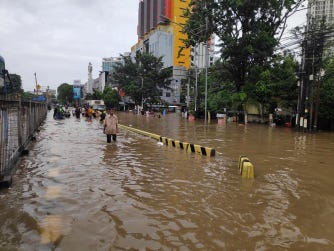
Figure 1. Residents wade through floodwater on JI.
(Photograph from Dhoni Setiawan, Residents wade through floodwater on JI, February 29, 2020, The Jakarta Post | photograph, https://www.thejakartapost.com/news/2020/02/28/jakarta-among-cities-most-threatened-by-risin g-sea-levels-extreme-weather-report.html).
From 1993 to the present, the global sea level rose about 100 millimeters.31 Though fluctuation of sea levels by about 10-15 millimeters yearly is normal, current levels are already detrimental to several industries in Southeast Asia.32 SLR is caused by global warming in two primary ways: thermal expansion (the expansion of water as it warms) and the melting of in-land ice (such as glaciers and ice sheets). Water has the ability to store more heat than air does, leading to the ocean absorbing 90% of the excess heat from global warming over the last 100 years.33 One-third of the reef cover on the planet is in Southeast Asia, but significant coral bleaching and inhibited coral growth occurred because of rising temperatures.34 Though the melting of ice caps in the ocean doesn’t significantly contribute to SLR, the melting of ice on land, that wasn’t already part of the mass of the ocean, does. Both the IPCC and the U.S. National Climate Assessment conclude that ice melting has been the largest contributor to SLR over the last few decades. Almost all countries in the ASEAN are in the top 50 countries that will experience severe weather impacts due to climate change, with four being in the top ten, making Southeast Asia one of the most at risk areas.35 Indonesia itself has the fifth largest low-elevation coastal population in the world, which is endangered by the rising sea levels.36 Indonesia is also a major contributor to climate change, however, and is a top ten emitter of greenhouse gases.37 This discordance between Indonesia’s actions and the best interests of its citizens makes it difficult to address both environmental protection and economic development. The threats of climate change and SLR are not limited to only the environment, as there have already been negative impacts on many industries that uphold the economy of Southeast Asia, leading to the displacement of hundreds of thousands of people. If SLR is left untreated, the economic benefits of using primarily fossil fuels, as Indonesia does, will be eclipsed by the decline of the tourism, fishing, and agriculture industries.
The tourism industry in Southeast Asia is a key industry in terms of GDP and job creation. After the Covid-19 pandemic, the area lost 8.4% in total GDP because of the drop in tourism.38 Indonesia and the Philippines are home to many cultural and natural wonders, some recognized by UNESCO and others being popular among tourists. For example, 35 million bleaching.39 Samarung, Indonesia–another popular tourist site–is at risk of being inundated by rising sea levels. This is an old city with a cultural heritage area and historic buildings, the Semarang Old City National Cultural Heritage Area, and its destruction poses a threat to the cultural heritage of Indonesia and the broader region. The capital city of Indonesia was changed from Jakarta to Nusantara in 2024 because of SLR. In 2021, the city was ranked as the world’s most vulnerable city to environmental threats, and since the 1970s, some parts of Jakarta have sunk four meters.40 It is estimated that by 2050, up to 95% of the city’s coastal areas will be submerged due to SLR.41 The broader cultural value of Southeast Asia is threatened because of this harm done to its cities. There are other sites in the region as well. For example, there are 50 World Heritage Sites in Southeast Asia, with 19 in Indonesia and 25 in the Philippines.42 Komodo National Park in Indonesia is composed of three major islands–Rinca, Komodo, and Padar–and is one of the only areas in the world, along with neighboring islands in Indonesia, inhabited by Komodo Dragons. The President of Indonesia set a goal of 500,000 foreign tourists to the island between 2016 and 2019 to boost the socio-economic development for the people in Flores Island, a larger island to the East of Komodo National Park.43 SLR poses a threat to the lowland habitat of the Komodo Dragon, and, along with other effects of climate change, increase its risk of extinction. The Komodo Dragon was listed as an endangered species in 2021, marking the beginning of a decline in this emblematic species.
The fishing industry in Southeast Asia is also affected by both SLR and ocean warming. The destruction of coral reefs reduces the amount of biodiversity in fish in the area, which destabilizes the world’s second-largest producer of seafood. The fisheries sector employs about 6.4 million Indonesians, and the fish products it creates account for 54% of the national animal protein intake (49 kilograms per person).44 Additionally, SLR increases coastal flooding and damages aquaculture infrastructure (fisheries, hatcheries, grow-out facilities, and processing plants). These infrastructures allow for less pressure put on marine natural resources and wild fish stocks, further helping the environment and innovating sustainable ways to continue farming fish. Aquaculture is also a growing industry in Indonesia, and the nation is emerging as a leader in the industry. Currently, 36% of the fisheries workforce works in aquaculture.45 SLR, in addition to ocean warming, creates extreme weather and high wave conditions, making it more difficult to fish for several weeks at a time. Its consequential landslides also affect 23% of fishing households, in comparison with 7% of nonfishing households.46 All of these factors contribute to the loss of income and food security to Indonesians. SLR has similar impacts on agriculture as it does on fisheries, but with even more citizens reliant on the food it produces and the money it brings them. The agriculture industry accounted for 12.4% of Indonesia’s GDP in 2024, and though this number is continuing to decrease, agriculture still serves as a pillar in the lives of millions of Indonesians.47 Flooding destroys farmland through saltwater intrusion, erosion, and inundation of water systems. The country was the world’s largest producer of palm oil and the 4th largest producer of rice.48 Agriculture also provides Indonesia itself with other staples that feed both people and livestock, such as corn.
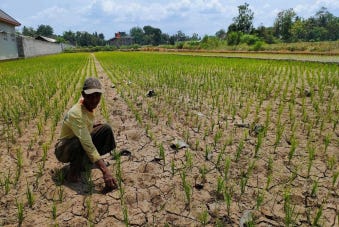
Figure 2. A person crouches in a dry agricultural field in Indonesia. (Photograph from Harian Jogja, [A person crouches in a dry agricultural field in Indonesia], July 16, 2025, Universitas Gadjah Mada | photograph,
https://ugm.ac.id/en/news/wet-drought-hits-indonesia-ugm-expert-warns-of-risks-and-opportuniti es-for-farmers/).
The destruction of farms through floods and droughts causes unpredictable agricultural work, which leads to a lack of steady income. Because 28.2% of Indonesia’s population, or about 78 million people, works in agriculture (as of 2023), a substantial portion of the workforce is left without income.49 Those who previously worked these jobs are more desperate to find work and leave the country, and therefore more vulnerable to manipulative work agreements. Oftentimes, people from Southeast Asian countries are trafficked to neighboring countries. For example, Malaysia is the most common destination for trafficking victims from Indonesia and the Philippines, and at least 80,000 Indonesians are estimated to be currently living illegally in Cambodia.50 The fishing industry is reportedly among the most exploitative industries in Indonesia, and a survey of 35 fishermen on Indonesian-flagged fishing vessels reported that 71% did not have possession of their identification documents and 88% had substantial salary deductions and irregular wages.51 In 2007, Indonesia criminalized all forms of labor trafficking, and since 2005, it has been using a “3P Approach”–Prevention, Protection, and Prosecution. Currently, its efforts to fight human trafficking are not as strong as they need to be.
Endemic corruption and official complicity, particularly in the fishing industry, have prevented proper law enforcement action. For example, the Indonesian government did not provide information about investigating alleged bribery of Indonesian diplomatic personnel to facilitate labor trafficking.52 In order to protect victims of trafficking, Indonesia collects data of trafficking victims, but the government lacks a comprehensive system to do so, and the data reported is incomplete and likely duplicative. On the other hand, the government is in partnership with NGOs to operate shelters and service centers for victims of trafficking crimes, as well as other various crimes. In an attempt to prevent human trafficking, the national anti-trafficking task force in Indonesia is co-chaired by the Coordinating Ministry of Political and Security Affairs and the Coordinating Ministry of Human Development and Culture, with INP as the Executive Chair.53 This task force, though, lacks reports on how often they meet or its budget. The task forces that are reported seem to lack funding, effective coordination, or an understanding of trafficking. In the 2025 Trafficking in Persons Report, the U.S. Department of State ranked Indonesia as Tier 2, meaning that the Government of Indonesia does not fully meet the minimum standards for the elimination of trafficking, though it is acknowledged that they are making efforts to do so.54 It is recommended that Indonesia increase efforts to investigate and prosecute trafficking crimes, as well as allowing shelter residents to move freely, possess their travel documents, and be able to work. Additionally, Indonesia is advised to proactively screen for trafficking indicators among vulnerable groups, such as workers in the fishing, palm oil, and extractive industries, as well as those employed in Chinese government-affiliated industrial parks and enterprises.
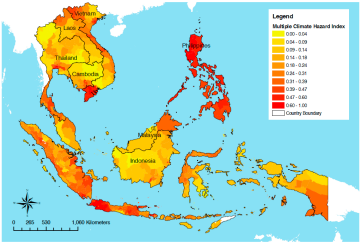
3. Multiple climate hazard map of Southeast Asia. (Map from Arief Anshory Yusof and Herminia Francisco. Multiple climate hazard map of Southeast Asia, January 2009, Economy and Environment Program for Southeast Asia | map,
https://research.fit.edu/media/site-specific/researchfitedu/coast-climate-adaptation-library/asia-a mp-indian-ocean/southeast-asia-amp-philippines/Yusuf--Francisco.--2009.---CC-Vulnerability-fo r-Southeast-Asia.pdf).
To address SLR in Southeast Asia and the Pacific, UN Global Pulse is collaborating with the Government of Indonesia, specifically, the Ministry of National Development Planning (Bappenas), to target areas that are most vulnerable.55 They are developing a support tool that integrates multiple data layers clustering methods to identify the areas requiring targeted interventions. It also includes a scenario planning tool that models the impacts of varying sea level rise stages and provides visual representations of potential impacts. If the pilot program is successful, this solution can be applied to other countries in the Asia Pacific region, with a focus on the Pacific Island countries. The UN also has programs to target human trafficking, globally and in Southeast Asia specifically. Since 2005, the IOM has also been working with the Indonesian Government to properly regulate migration, trail law enforcement to properly respond to human trafficking cases, and work with the Indonesian Migrant Workers’ Union to protect migrant workers from exploitation.56 On a global scale, the Office of the United Nations High Commissioner for Human Rights is working on capacity development, research and knowledge production, and partnerships with agencies such as the Inter-Agency Coordination Group against Trafficking.
Bibliography
Ashworth, James. “Komodo dragon is now listed as Endangered as rising sea levels threaten its survival.” Natural History Museum, September 10, 2021.
https://www.nhm.ac.uk/discover/news/2021/september/komodo-dragon-is-now-listed-as endangered-from-rising-sea-levels.html
Association of Southeast Asian Nations Energy Database System. “Rising Sea Levels Put ASEAN Cities at Risk.” Accessed December 2, 2025. https://aseanenergy.org/news-clipping/rising-sea-levels-put-asean-cities-at-risk/
Bacani, Xyza Cruz. “Climate Change and Human Trafficking in Indonesia.” Pulitzer Center October 23, 2018. https://pulitzercenter.org/projects/climate-change-and-human-trafficking-indonesia
Bacani, Xyza Cruz. “No Man’s Land.” Pulitzer Center, September 18, 2018. https://pulitzercenter.org/stories/no-mans-land
Caballero-Anthony, Mely. “A Hidden Scourge.” September 2018. https://www.imf.org/en/Publications/fandd/issues/2018/09/human-trafficking-in-southeas t-asia-caballero
City of Alberquerque. “ABQ BioPark Contributes to Komodo Dragon Conservation Work in Indonesia.” June 23, 2025. https://www.cabq.gov/artsculture/biopark/news/abq-biopark-contributes-to-komodo-drag on-conservation-work-in-indonesia
Climate Change Knowledge Portal. “Sea Level Change, Historical.” December 2, 2025. https://climateknowledgeportal.worldbank.org/country/indonesia/sea-level-historical
Dickinson, Daniel. “What is sea level rise and why does it matter to our future?.” United Nations, August 26, 2024. https://news.un.org/en/story/2024/08/1153596
Food and Agriculture Organization of the United Nations. “FAO Report: Global fisheries and aquaculture production reaches a new record high.” July 6, 2025. https://www.fao.org/newsroom/detail/fao-report-global-fisheries-and-aquaculture-product ion-reaches-a-new-record-high/en
Francisco, Herminia and Yusof, Arief Anshory. “Climate Change Vulnerability Mapping for Southeast Asia.” Economy and Environment Program for Southeast Asia, January 2009. https://research.fit.edu/media/site-specific/researchfitedu/coast-climate-adaptation-library /asia-amp-indian-ocean/southeast-asia-amp-philippines/Yusuf--Francisco.--2009.---CC-V ulnerability-for-Southeast-Asia.pdf
Hasibuan, Hayati Sari, Putri, Kirana Anindita, and Tambunan, Rudy Parluhutan. “The Impact of Rising Sea Levels on Historical Sites Old City Semarang.” E3S Web of Conferences, January 1, 2021. https://www.e3s-conferences.org/articles/e3sconf/pdf/2021/93/e3sconf_icenis2021_0401 2.pdf
International Coral Reef Initiative. “South East Asia Factsheet.” 2018. https://icriforum.org/wp-content/uploads/2019/12/ICRI%20South%20East%20Asia%20F actsheet_0.pdf
International Organization for Migration. “Counter Trafficking.” Accessed December 3, 2025. https://indonesia.iom.int/counter-trafficking
International Trade Organization. “Indonesia Country Commercial Trade.” November 17, 2025. https://www.trade.gov/country-commercial-guides/indonesia-agriculture
Kumala, Masitha Tismanada, Serfiyani, Cita Yustisia, and Vinata, Ria Tri. “Climate change and the reconstruction of Indonesia’s geographic basepoints: Reconfiguration of baselines and Indonesian Archipelagic Sea lines.” Marine Policy, February 2023. https://www.sciencedirect.com/science/article/pii/S0308597X22004900#fig0005
Kusrini, Mirza, Mahmud, Arief, Mardiastuti, Ani, and Prasetyo, Lilik Budi. “Examining the consequences of tourism development on the habitat of Komodo dragons in Labuan Bajo.” IOP Conference Series Earth and Environmental Science, July 2024. https://www.researchgate.net/publication/382386671_Examining_the_consequences_of_t ourism_development_on_the_habitat_of_Komodo_dragons_in_Labuan_Bajo
Langlouis, Breanne, Simpson, Ryan, Anyanwu, Oyedolapo, Marsh, Elizabeth, Taylor, Salima, and Naumova, Elena. “Evaluation Indirect Impacts of Climate Change on Fishing and Farm Productivity Using the Indonesian Family Life Survey: An Example Exploring Natural Disasters and Migration.” Current Developments in Nutrition, June 2022. https://www.sciencedirect.com/science/article/pii/S247529912307659X
Leiserowitz, Anthony, Rosenthal, Seth, Verner, Marija, Lee, Sanguk, Ballew, Matthew, Carman, Jennifer, Goldberg, Matthew, Marlon, Jennifer, Paramita, Enggar, Chamim, Mardiyah, Mohamad, Paramita, and Daggett, Matthew. “Climate Change in the Indonesian Mind.” October 3, 2023. https://climatecommunication.yale.edu/publications/climate-change-in-the-indonesian-mi nd/toc/3/
Marine Stewardship Council. “Fish for Good - Indonesia.” Accessed December 3, 2025. https://www.msc.org/what-we-are-doing/pathway-to-sustainability/fishforgood/indonesia
National Aeronautics and Space Administration. “Ocean Warming - Earth Indicator.” December 2024. https://science.nasa.gov/earth/explore/earth-indicators/ocean-warming/
National Ocean Service. “Is sea level rising?.” June 16, 2024. https://oceanservice.noaa.gov/facts/sealevel.html
The Nature Conservancy. “Transforming Indonesia’s Fisheries.” December 3, 2025. https://www.nature.org/en-us/about-us/where-we-work/asia-pacific/indonesia/stories-in-i ndonesia/indonesia-fisheries/
Nguyen, Thu Giang and Phi, Minh Hong. “Hot and Bothered: Climate Challenges for ASEAN’s Tourism Reopening.” June 16, 2022. https://fulcrum.sg/hot-and-bothered-climate-challenges-for-aseans-tourism-reopening/
Nugroho, Agung. “Wet Drought Hits Indonesia, UGM Expert Warns of Risks and Opportunities for Farmers.” Universitas Gadjah Mada, July 26, 2025.
Panggabean, Romauli. “Urgent Need to Safeguard Indonesia’s Agricultural Future.” World Resources Institute Indonesia, May 21, 2025. https://wri-indonesia.org/en/insights/urgent-need-safeguard-indonesias-agricultural-future
Phun, Kevin. “The role of tourism at heritage sites in SE Asia affected by effects of global warming.” Southeast Asia Research Academy, May 18, 2024. https://www.searanetwork.org/post/how-can-tourism-aid-heritage-sites-in-southeast-asia affected-by-global-warming
Sanyal, Debendra. “Rising Sea Levels and the Threat Posed to South and Southeast Asia.” Asia in Global Affairs, April 20 2024. https://www.asiainglobalaffairs.in/Commentary/rising-sea-levels-and-the-threat-posed-to south-and-southeast-asia/
Setiawan, Agus and Siry, Hendra Yusran. “Climate Change Impacts on Fisheries and Aquaculture in Indonesia: Current Initiatives and Challenges for Adaptation and Mitigation.” Food and Agriculture Organization, May 24-26, 2011. https://openknowledge.fao.org/server/api/core/bitstreams/bd45aa7a-42b6-4cd6-923a-b7fc 7d7a6878/content
Smith, Paige. “The Impact of Coral Degradation on Coastal Communities in Southeast Asia.” February 2025. https://ballardbrief.byu.edu/issue-briefs/the-impact-of-coral-degradation-on-coastal-com munities-in-southeast-asia
Sutrisno, Budi. “Jakarta among cities most threatened by rising sea levels, extreme weather: Report.” The Jakarta Post, February 29, 2025. https://www.thejakartapost.com/news/2020/02/28/jakarta-among-cities-most-threatened-b y-rising-sea-levels-extreme-weather-report.html
United Nations Educational, Scientific, and Cultural Organization and International Union for Conservation of Nature. “Report on the Joint Heritage Centre/IUCN reactive monitoring mission to Komodo National Park (Indonesia).” March 1-7, 2022. https://unesdoc.unesco.org/ark:/48223/pf0000390551
United Nations Educational, Scientific, and Cultural Organization World Heritage Convention. “Convention Concerning the Protection of the World Cultural and Natural Heritage.” September 10-25, 2023. https://whc.unesco.org/document/199684
United Nations Educational, Scientific, and Cultural Organization World Heritage Convention. “Komodo National Park.” Accessed December 2, 2025. https://whc.unesco.org/en/list/609/
United Nations Educational, Scientific, and Cultural Organization World Heritage Convention. “World Heritage List.” Accessed December 3, 2025. https://whc.unesco.org/en/list/
United Nations Global Pulse. “Addressing Sea Level Rise in Asia and the Pacific.” 2024. https://www.unglobalpulse.org/project/addressing-sea-level-rise-in-asia-and-the-pacific/
U.S. Department of Agriculture. “Production - Rice.” Accessed December 3, 2025. https://www.fas.usda.gov/data/production/commodity/0422110
U.S. Department of Agriculture. “Production - Palm Oil.” Accessed December 3, 2025. https://www.fas.usda.gov/data/production/commodity/4243000
U.S. Department of State. “2025 Trafficking in Persons Report: Indonesia.” Accessed December 3, 2025. https://www.state.gov/reports/2025-trafficking-in-persons-report/indonesia/
World Bank Group. “Agriculture, forestry, and fishing, value added (% of GDP) - Indonesia.” 2024. https://data.worldbank.org/indicator/NV.AGR.TOTL.ZS?locations=ID
World Bank Group. “Employment in agriculture (% of total employment) (modeled ILO estimate) - Indonesia.” 2023. https://data.worldbank.org/indicator/SL.AGR.EMPL.ZS?locations=ID
Romance of the Delivery Kingdoms
Kaden Silva, Managing Editor
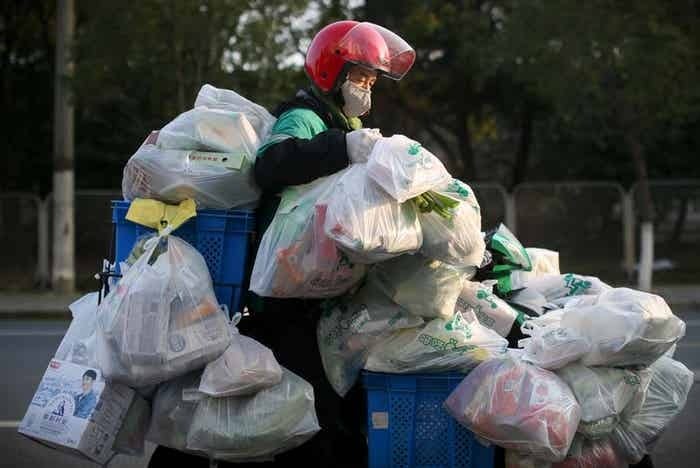
Figure 1. Zhu Weihui, A food delivery driver in Shanghai Photograph. Business Insider (Pengpai News). Feb. 11, 2020. https://www.businessinsider.com/photo-wuhan-coronavirus-food-delivery-worker-2020-2
Beginning in February, a large Chinese e-commerce company, JD.com, announced its entry into the food delivery business. Meituan and Alibaba - each running their own food delivery platforms - already occupied parts of the increasingly competitive food delivery sector. JD.com’s entry signaled the start of a price war. Each competitor drove one another in a race to the bottom, where each platform drove the costs of common items such as tea and coffee to 1 yuan, or even sold them for free.57 The conflict’s effects spilled both into the consumer and merchant side of food delivery, as well as dragging the competitors’ stock prices down. Meituan, in a statement, cited “irrational competition” as a major cause, wherein their stock price plunged around 13% in one day.58 The Chinese government has taken notice of the situation, addressing increasing scrutiny towards the companies for their perceived reckless practices, taking steps to draft legislation, and signaling intention for crackdowns on the price war.
This article will cover a short history of the food delivery sector, what’s happened up to this point, and historical trends in Chinese economic ‘involution’ within the food delivery sector and beyond.
Background
Meituan and Ele.Me, prior to JD.com’s entry to the market, were already established competitors. Meituan was founded on March 4th, 2010 by Wang Xing. Their business framework is focused on food delivery, with forays into other fields such as hospitality and travel. Through a combination of group buying and adopting new e-commerce technologies to reduce costs, Meituan captured around 65% of the food delivery market share within the first decade of its inception.59 The business frames itself as a ‘social’ endeavor — filling the demands of consumers by shaping operations to their needs. In 2018, Alibaba acquired Ele.me in a move to strengthen its own logistics, as well as gain entry to the growing food delivery industry.60
The food delivery sector provides a unique perspective into modern Chinese urbanization and Chinese consumer preferences. Statistical snapshots of the food delivery sector, according to iiMedia research, illuminate key qualitative factors in understanding this perspective. A majority of the consumer base live in cities; for example, in 2017, 1.87 million users — 60.8% of the tabulated user base — were food delivery consumers in Tier 1 and Tier 2 cities.61 Tier 1 cities were coded as major Chinese cities — Beijing, Guangzhou, and Wuhan to name a few. Examples of Tier 2cities include Jinan, Wenzhou and Harbin. Furthermore, the cumulative percentage of Tier 1 and Tier 2 city food delivery consumers decreases going into 2018. This is due to the increase in users in cities coded as Tier 3 and Tier 4, as defined by iiMedia. This cumulative decrease illustrates the widespread adoption of these services. These services rely on access to digital and physical infrastructure to facilitate food delivery, spreading outward from urban centers to fill demand in the periphery. Out of the multiple studies conducted on Chinese food delivery users, a large number of respondents demographically fall on the younger side. In Tian Yu and Seiichi Sakurai’s study on customer perception vis-a-vis food delivery services, they collected 184 respondents ; 120 were students, and 64 were workers.62 Even if sampling bias played a part in creating this demographic picture, it is telling that the majority of the accessible sample had the digital literacy to participate in food delivery service. The market for food delivery is yet fully mature, creating this market-oriented ‘Wild West’ wherein major food delivery competitors race to attain market share in a rapidly shrinking consumer-base.
The individual driver mirrors consumer preferences on the job-seeking side. The growth of the Chinese ‘gig-economy’ facilitated movement of labor into this industry. The demographic of delivery drivers consist of rural-urban migrants, in comparison to their western peers — international students and ‘noncitizen migrants.’63 In a qualitative study conducted by Wei Wan, Weihua Liu, and Huiling Hu, they capture this urban-rural divide as well. In one testimony, an interviewee said, “I come from a small village. I don’t know anyone in the city. I have no one to rely on but myself. I find it so hard to find a job without connections…”64 These trends are reflective of the cumulative increase in food delivery users in iiMedia’s Tier 3 and Tier 4 cities. Delivery drivers in China are uniquely embedded into the business apparatus; competing firms hire fiercely, often offering higher bonuses when delivering a higher quantity of orders. Mobile adoption is integral to employment — the labor process, work assignments, performance and evaluations all rely on digital access.65 These are some of the factors contributing to the intensity of the three-way price war on the employer side.
The First Volley
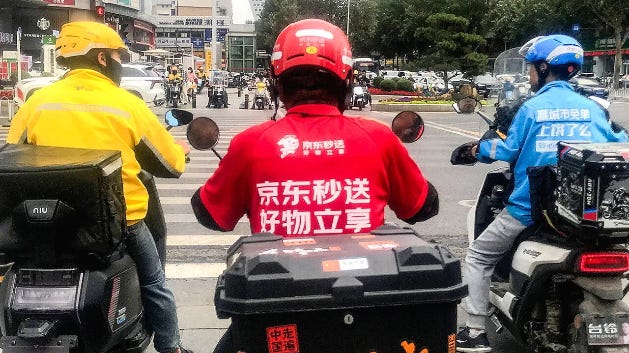
Figure 2. Charge of the Traffic Light Brigade. Photograph. The Economist. Jul. 31st, 2025. https://www.economist.com/china/2025/07/31/everyone-loses-in-the-rage-of-chinas-delivery-wars
JD.com announced on February 11th, 2025 the creation of a new food delivery service, and a recruitment call for participating vendors.66 JD.com already experimented with the idea of food delivery, introducing the concept piecemeal with coffee and tea deliveries. As JD established itself in the market, SCMP reported in early June Meituan controlled around 70% of the market share, with the other food delivery companies vying for the remaining 30% of the sales.67 A Chinese outlet named Leiphone allegedly scraped the data from internal Meituan operations. This set off the cascade of subsidies flooding the Chinese food delivery market between the three giants. The Economist reported in July the tactics each company employed in waging the price war. They expanded options for vendored goods, and tried to drive both prices and delivery times down to retain customers on their platforms. For example, to attack JD, Alibaba offered ‘instant purchases’ of goods such as electronics, promising delivery in under an hour.68 The competitors subsidized drink prices down to ludicrously low numbers, with some cases of teas and lattes being sold for free.
For vendors on the ground, the price wars began cutting into their quality control and revenue. The Economist drew on the testimony of Jiangsu businessman, He Wei, to illustrate the bind for many Chinese vendors caught in the headwinds of the price wars. “Mr. He says his revenue from on-premises dining has shrunk by 30% since April. His revenue for deliveries has jumped by 20% during that time, but profits on deliveries have tumbled by more than 20%.”69 It was a lose-lose situation. If vendors did not match the cratering prices in the cost of doing business and in their pricing, they ran the risk of losing business. Chinese consumers were directly placing orders through the major food delivery companies, sometimes within the restaurants themselves, to take advantage of the subsidies. By price matching, Chinese restaurant vendors had to find where to cut costs to make price matching feasible while staying in business. While Mr. He testified his commitment to safe ingredients, there is no telling what other vendors did in order to keep up with the sudden surge of competition.
The vanguard of the food delivery wars, the drivers, also found themselves in the crossfire. The infancy of the food delivery industry facilitated poor working conditions for delivery drivers. The rural-urban immigrants that make up the core of Chinese food delivery drivers reported multiple difficulties they encountered in their day to day work. Another driver’s testimony stated, “Last year, I only had to work 10 hours a day and my monthly income was over 10,000 RMB (around $1400). But now I have to work 13 hours a day and my monthly income is less than 8000RMB (approximately $1,118).”70 Income aside, they also report poor working conditions, algorithm-driven delivery standards dictating astonishing delivery speed standards, and a lack of essential work benefits.71 In the midst of crashing prices, many drivers reported income per delivery falling further below pre-war prices. Drivers worked longer hours for the same pay, because of the by-delivery nature of their wage. Cascading promises for fast delivery forced drivers to put their lives on the line and drive recklessly in traffic; hospital reports showed an increase of traffic related accidents.72 For the consumer, the first couple months created a feeding frenzy for delivery service users. Chinese netizens flooded social media with posts showing off their hauls. According to Powercommerce, Meituan experienced a period of 120 million same-day orders (100 million of which were food orders), while the other competitors processed around 80 million.73
The Chinese government quickly took notice. The Chinese Politburo, on July 24th, published proposed changes to the country’s price law, the first amendment since enactment in 1998. The wording is vague — the draft amendment would ban companies from selling items below a price calculated from their “pricing mechanism,” referencing algorithms commonly used on e-commerce platforms.74 Furthermore, in the same timeframe, Xi Jinping issued a vague statement aimed at major delivery competitors, declaring further participation in the price wars subject to future regulation.75 The Politburo made addressing the price wars their top regulatory priority, especially because this ‘involution’ — a term that Chinese netizens coined to describe this phenomenon — is already prevalent outside of the food delivery sector. The term is not well–explored, and it merits further research. However, it is one way to describe the overall industry patterns present in the delivery company price war. Some even argue that this pattern is a necessary growth pain to promote economic growth.
Conclusion
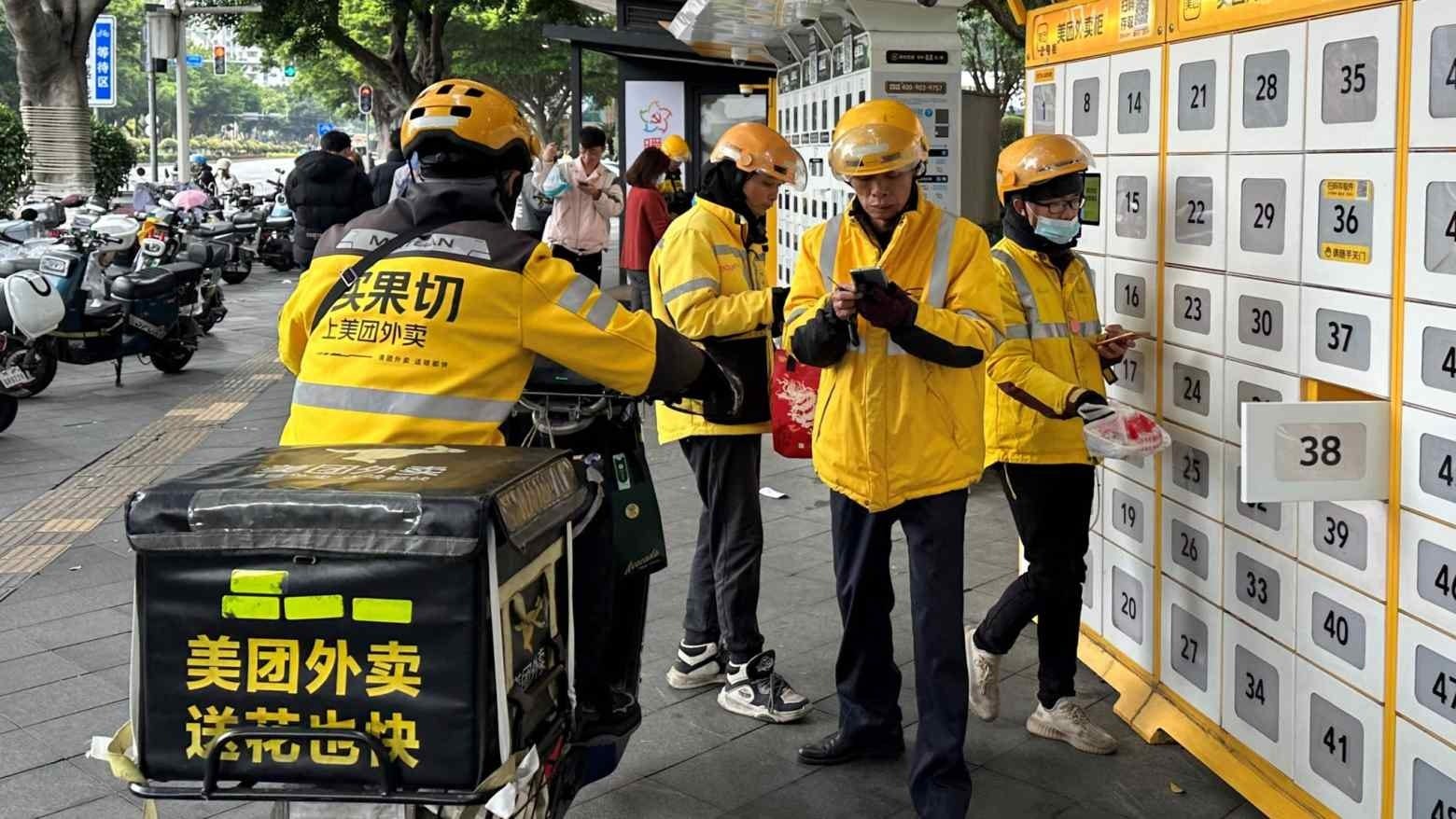
Figure 3. Takashi Kawakami. Meituan delivery drivers can be seen buzzing around Guangzhou’s office areas on weekdays. Photograph. Nikkei Asia. Feb. 28, 2024. https://asia.nikkei.com/business/business-trends/china-s-food-delivery-market-explodes-to-208bn-as-workers-scrape-by.
All three competitors reported heavy losses going into the end of 2025; JD.com reported a 55% drop in net profit for the three months up to September, and Alibaba’s net income to shareholders dropped by 52% to 21 billion yuan from 43.9 billion yuan a year before.76 The Politburo has not announced immediate policy pursuant to directly controlling these price wars; it is unclear if there are talks behind closed doors with leaders in this industry to potentially curb the price wars informally. For the consumer, the era of free lattes is over, but the price wars still rage on between the three competitors. Until the Chinese Politburo steps in with explicit regulation and policy control, the nature of the Chinese domestic market will continually pit them against each other in an existential race to the bottom.
Bibliography
Burtch, Gordon, Seth Carnahan, and Brad N. Greenwood. “Can You Gig It? An Empirical Examination of the Gig Economy and Entrepreneurial Activity.” Management Science 64, no. 12 (2018): 5497–520. https://doi.org/10.1287/mnsc.2017.2916.
Chen, Wency, and Anne Cao,. “Meituan Slides into Loss in ‘Milk Tea’ Subsidy War with Instant Commerce Rival Alibaba.” South China Morning Post (Shanghai), November 28, 2025. https://www.scmp.com/business/china-business/article/3334568/meituan-slides-loss-milk-tea-subsidy-war-instant-commerce-rival-alibaba.
Powercommerce. “China’s Food Delivery Price Wars: A Deep Dive into the Frenzy of Discounts and Chaos.” August 29, 2025.
Sun, Ping. “Your Order, Their Labor: An Exploration of Algorithms and Laboring on Food Delivery Platforms in China.” Chinese Journal of Communication 12, no. 3 (2019): 308–23. https://doi.org/10.1080/17544750.2019.1583676.
Tan, Huileng. “China’s Era of One-Yuan Lattes and Cheaply Delivered Meals Is Cratering.” Business Insider, n.d. https://www.businessinsider.com/china-food-delivery-price-war-involution-competition-alibaba-jd-meituan-2025-8.
The Economist. “Everyone Loses in the Rage of China’s Delivery Wars.” July 31, 2025. https://www.economist.com/china/2025/07/31/everyone-loses-in-the-rage-of-chinas-delivery-wars.
Wan, Wei, Weihua Liu, and Huiling Hu. “The Career Development of Food Delivery Riders in China: A Qualitative Investigation.” Preprint, In Review, October 8, 2024. https://doi.org/10.21203/rs.3.rs-4935308/v1.
Wang, Hannah. “Meituan’s Food Delivery Market Dominance in China Remains Stable at 70%, Report Says.” South China Morning Post, June 19, 2025. South China Morning Post.
Wang, Yimin. “JD.Com Does Food Delivery Now? With Zero Commission?” Dao Insights, February 12, 2025. https://daoinsights.com/news/jd-com-does-food-delivery-now-with-zero-commission/.
Wang, Yue. “Alibaba Moves To Swallow Up China’s Ele.Me Food Delivery Service.” Forbes, February 28, 2018. https://www.forbes.com/sites/ywang/2018/02/28/alibaba-moves-to-swallow-up-chinas-ele-me-food-delivery-service/.
Wu, Philip F., Ruoshu Zheng, Ying Zhao, and Yixi Li. “Happy Riders Are All Alike? Ambivalent Subjective Experience and Mental Well‐being of Food‐delivery Platform Workers in China.” New Technology, Work and Employment 37, no. 3 (2022): 425–44. https://doi.org/10.1111/ntwe.12243.
Xie, Yanmei. “An Anatomy of Industrial Involution in China.” RAND Corporation, October 24, 2025. https://www.rand.org/pubs/commentary/2025/10/an-anatomy-of-industrial-involution-in-china.html.
Yu, Tian, and Seiichi Sakurai. “Customer Perception of Online Food Delivery and Analysis of Factors Affecting Customers – Based on Young Chinese Customer Behavior Survey.” Asian Business Research 7, no. 5 (2022): 1. https://doi.org/10.20849/abr.v7i5.1272.
Zhang, Yiqi, Xinyu Deng, and Mingyue Wang. “Analysis of Food Delivery Market in China: A Case Study of Meituan.” Paper presented at 2021 5th International Seminar on Education, Management and Social Sciences (ISEMSS 2021), Chengdu, China. 2021.https://doi.org/10.2991/assehr.k.210806.050.
The Economic Impact in Developing Nations of US-Funded Family Planning Services
Sara Weinstein, Staff Writer
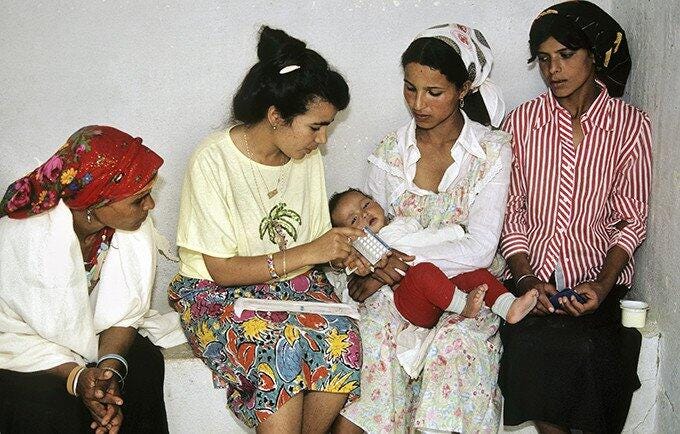
Figure 1. Isaac, John. Women learn about family planning at a clinic in Tunisia in 1987. 1987. Photograph. UN. https://eeca.unfpa.org/en/news/fifty-years-ago-it-became-official-family-planning-human-right
Recently, there has been a significant decrease in United States funding for foreign aid in tandem with the decision to end the United States Agency for International Development (USAID) program and its subsidiaries. One of the lesser discussed consequences of this move will have a drastic impact on the women and girls who compose nearly half of the developing world’s population.77
For the past several decades, across party lines and presidential administrations, the US provided funding for family planning services across the developing world. These services include providing family counseling, contraceptives, and treatment for sexually transmitted diseases. Largely through donations to providers, the US is responsible for $607.5 million annually in global funding for family planning services, comprising around 40% of global funding for family planning services and providing care for tens of millions of women worldwide. 47.6 million women receive contraceptive care alone as a result of US funding.78
These services, possible on the necessary scale only with US funding, are essential to the women and girls of developing nations. But it’s not just the women and girls of developing nations who would be lost without these services. It’s also the economies - regional, national, and international. Historical studies find a direct link between the provision of contraceptives to girls and young women and earning potential and educational outcomes. Girls granted access to family planning services by the age of 18, on average, attain high school and post-secondary degrees at significantly higher rates and have much higher earning potential than girls without access to these services.
Educational attainment, gainful employment of women, and the ability to plan pregnancies in relation to family size and length of time between births have significant benefits. They are directly linked to not only better outcomes for mothers but also improved investment in children. Thus, they are also linked to improved educational outcomes and improved mental and behavioral development.79 These benefits directly result from the availability of family planning services. Without US funding, these services are not available on the necessary scale to women, girls, and families in developing nations.80
These services are essential to millions of people globally. $607.5 million of US funding for family planning serves 47.6 million women and couples across 41 developing nations. Annually this averts 34,000 maternal deaths by preventing 7.6 million unplanned births and 5.2 million unsafe abortions annually. It also leads to 17.1 million fewer unwanted pregnancies each year.81 However, a recent stop-work order from the Trump Administration froze all family planning funding, also excluding family planning services by name from the waiver issued permitting “life saving services” to continue.82 Despite their discontinuation, these services are essential. The 34,000 estimated maternal deaths averted by US funding every year will no longer be averted without these resources. This funding saves lives, yet is considered non-essential, as well as not providing “life saving services.”
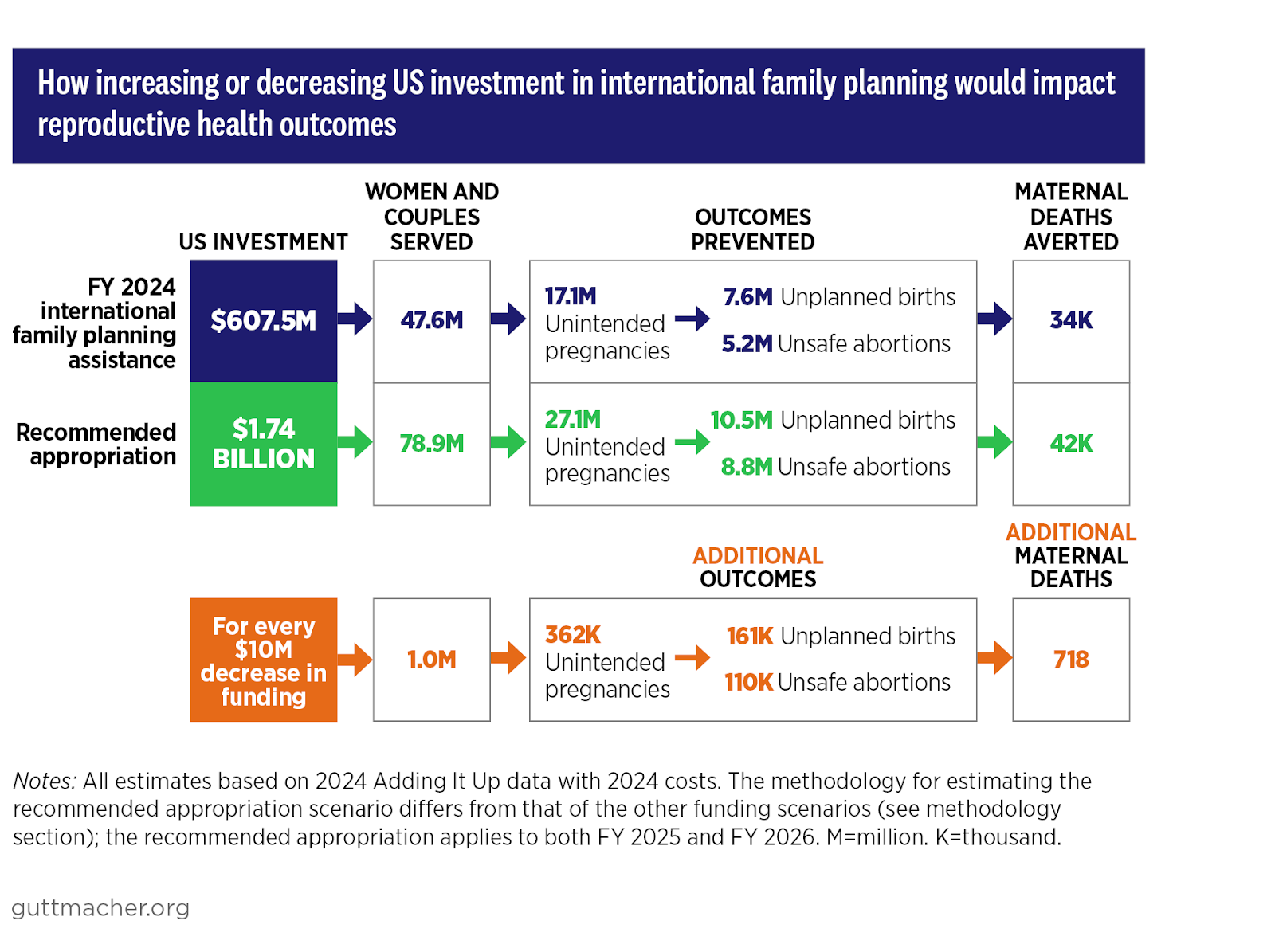
Figure 2. Damavandi, Samira, Elizabeth A. Sully, Amy Friedrich-Karnik, and Mira Tignor. How increasing or decreasing US investment in international family planning would impact reproductive health outcomes. (Guttmancher Institute, 2025) https://www.guttmacher.org/2025/02/just-numbers-impact-us-international-family-planning-assistance-2024
The additional 7.6 million unplanned births and 17.1 million unplanned pregnancies no longer averted through US funding will also have lifelong health implications for both the people giving birth and the children they give birth to. A study of 524,000 individuals found disastrous impacts of unplanned pregnancy and birth on both mothers and infants among pregnancies that reached full term.83 Unintended pregnancy is associated with higher rates of domestic violence, pre- and post-natal depression, and poorer maternal health behaviors. In infants, it is associated with pre-term birth, low birth rates, and delayed and/or insufficient care pre and post natal.84 By preventing these unplanned births and pregnancies, funding for family planning services improves maternal health outcomes and allows families and individuals to plan pregnancies for a time in which they are better able to care for children.
Abortion services made accessible by US funding are essential to women and girls in the 41 nations which receive US funding. These are pregnant individuals who would have sought out abortion regardless of the provider. But, with US funding, these individuals are able to receive safe, reliable abortions. US funding for contraceptive services prevents 5.2 million unsafe abortions from occurring annually. Safe abortions, defined as a WHO-approved method performed using the correct equipment by a trained professional, are provided as an alternative, protecting women and girls in developing nations and reducing one of the leading causes of maternal death. Unsafe abortion can result in life-long injuries and/or disability, heavy bleeding, infection, damage to internal organs, or loss of the ability to become pregnant in the future.85 Severe complications occur in around 1 in every 4 unsafe abortions.86 In comparison, safe abortions have a rate of complication (severe and minor) of only 2%. To the millions of women who will seek out abortion regardless of the provider, safe abortion as enabled by US funding is essential.
The contraceptives also funded by US assistance for family planning come largely in the form of barrier methods, birth control pills, implants, and emergency contraceptives. They prevent pregnancy, spread of Sexually Transmitted Diseases (STDs) and Sexually Transmitted Infections (STIs), as well as regulate hormonal cycles, among other purposes. In terms of STD and STI prevention, US-funded contraceptives are essential. Condoms prevent the spread of certain prevalent STDs and STIs such as HIV, HPV, and chlamydia by 98% when used correctly, compared to 89% when not used perfectly and 0% when not used at all.87 Condoms, along with other barrier methods such as dental dams and internal condoms, are essential in preventing the spread of STDs and STIs, especially in regions where treatment is not easily accessible.
Spread of STIs such as HIV/AIDS is prevalent in many developing countries due to the inaccessibility of treatment. In sub-Saharan Africa, as much as 47% of STDs are treated on a delayed timeline, making treatment more difficult and exacerbating long-term consequences.88 By preventing the spread of STDs in the first place, the number of individuals requiring treatment can be significantly reduced, thus making treatment more accessible to patients and easier to manage for providers.
Commonly prescribed forms of oral and implanted contraceptives (specifically pills, injection, implant, IUDs, and hormonal patches) are all over 90% effective when used typically and over 99% effective when used perfectly.89 This is in comparison to natural family planning (most commonly tracking hormonal cycles and extending breast feeding) and non-scientific methods such as withdrawal, which range from less than 50% to around 75% effective even when performed perfectly.90 An estimated 47.6 million women, girls, and couples rely on US funding specifically for their contraceptive care. As previously noted, US investment in global family planning services prevents 17.1 million unintended pregnancies each year, with an additional 362,000 unintended pregnancies prevented for every additional $10 million in US investment.91 In large part, this is due to the provision of contraceptives for the purpose of preventing unwanted pregnancy.
Without these contraceptives, there would be a much higher incidence of unwanted pregnancy, which has negative impacts on both the parent(s) and infant. Maternal consequences of unplanned pregnancy include higher rates of domestic violence and pre- and post-natal depression, as well as greater incidence of premature birth. For infants, unintended pregnancy is associated not only with lower weight at birth, but also insufficient and/or delayed pre and post natal care. Contraceptives, in slowing the spread of STDs and STIs and preventing unintended pregnancy, are essential to the wellbeing of entire communities and nations.
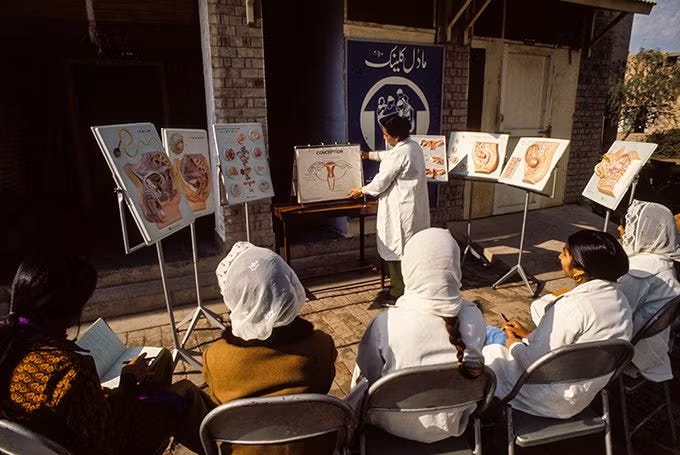
Wolf, B. Women attend a class in family planning in Pakistan in 1973. 1973. Photograph. UN.
https://eeca.unfpa.org/en/news/fifty-years-ago-it-became-official-family-planning-human-right
This is why cuts to family planning services will impact economies. The most straightforward way in which cuts to family planning services can hurt economies is a decrease in workforce. 95% of women in South Asia and 89% of women in sub-Saharan Africa are employed in informal sectors as a share of overall employment.92 Female employment in the informal labor market is integral to the economies of low and middle income countries.
When women are unable to exercise reproductive freedom, they are less able to participate in the workforce. Because unskilled jobs, which comprise 90% of the informal labor market are, so physically demanding, women and girls are unable to perform them in the later stages of pregnancy and post-partum.93 More than that, when women unexpectedly have a child and cannot access outside childcare, as is most often the case in such situations, they are unable to work. Mothers who cannot access outside childcare are forced to create their work schedule around childcare, making them less able to contribute to the economy.
When women cannot access contraceptive care and fall pregnant as a result, they cannot achieve gainful employment, often for several years. Thus, many of the 46.7 million women and couples serviced by US funding for family planning services will be unable to seek employment, nor contribute to their regional economies. Even at the most conservative estimates, the women experiencing the 7.6 million unplanned births and 5.2 million unsafe abortions annually averted by US funding will be unable to seek gainful employment as a result of their physical health and/or having to care for a child they are not financially equipped to plan for.
Further, when people are unable to work out of need to care for a child, they require assistance to support themself and their child. In most cases, the 7.6 million+ infants who were not planned for require outside assistance for food, household essentials, healthcare, clothing, and, of course, a caregiver. This requires programming from the government providing food, medical care, and subsidies to the primary caregiver for the infant, which adds up to billions of additional costs annually to nations that already struggle to provide such services. The financial costs of such programs to the governments of low and middle income nations would be disastrous.
Tax revenue will also be impacted as a result of the US cuts to funding for family planning services. Millions of unplanned children means millions of parents who are unable to seek employment while they provide necessary childcare. As a result, millions of individuals are no longer paying income taxes. With that said, personal income tax does not compose a significant percentage of tax revenue in lower income countries. Most low income countries garner around 10% of their tax revenue from personal income taxes, although the IMF believes that this percentage is set to increase, as it has nearly doubled in the past three decades.94 Lower income nations also tend to have lower tax rates, around 25-35% in most of sub-Saharan Africa and South Asia, compared to 40-50% in high income nations.95 Based on GDP, low income nations typically generate $5.6 billion a year in income tax revenue.96 This decrease in revenue is coupled with an increase in strain on assistance programs and greater need for revenue. As a result, decreases in family planning funding stand to create significant problems for the governments of low income nations.
It’s not just income taxes that will suffer as a result of cuts to family planning services - it’s also GDP. When women and girls experience unplanned pregnancy and birth, they are unable to complete the physical labor they are almost always employed in. As a result, they are unable to work, garner income, or contribute to GDP for extended periods of time following unplanned pregnancy and birth. And, as a result of losing millions of workers per annum, GDP also suffers. The informal market comprises 35% of GDP on average in low and middle income nations, and the percentage gets even higher among lower income nations. Given that able-bodied women comprise around 60% of the informal workforce (an exact number is difficult to estimate), this sector will be devastated by a significant reduction in workforce.97 This spells economic disaster for the 41 low and middle income nations reliant on US funding to provide family planning services to their citizens.
Referred to as recessions or, in more extreme cases, depressions, significant contractions in GDP are devastating to nations and entire regions. For individuals, loss in GDP means higher unemployment, lower wages, and dangerously high inflation, making it harder for people to provide for themselves and their families. Even moderate decreases in GDP have a direct correlation with worsened quality of life for individuals. For corporations, this means lower sales and, correspondingly, lower profits. This, in turn, leads to lower direct foreign investment in low and middle income countries, which slows the speed of development and thus worsens quality of life, inflation, and employment prospects for citizens of developing nations. Falling GDP creates a cycle of devastation that brings economic ruin to entire countries and populations.98
Cuts to family planning services are devastating on every level. They lead to much higher incidence of unplanned pregnancy and birth and STDs and STIs. More than that, they lead to higher levels of unsafe abortion, health complications for mothers and infants, and inaccessibility of treatment for STDs and STIs. In economic terms, cuts to family planning funding by the US will lead to a significant decrease in the informal labor force, greater strain on social welfare, and the potential for significant damage to GDP in low and middle income nations, 41 of which receive US funding for family planning services, with a total of 47.6 million women and couples served. All in all, there will be devastating impacts to this funding being terminated.
Bibliography
“Accelerating Sustainable Financing for Family Planning: Insights and Advocacy Recommendations Accelerating Sustainable Financing for Family Planning: Insights and Advocacy Recommendations.” Family Planning 2030, July 2025. https://www.fp2030.org/app/uploads/2025/07/Financing-impact-brief.pdf.
Barbuscia, Anna, Ariane Pailhé, and Anne Solaz. “Unplanned Births and Their Effects on Maternal Health: Findings from the Constances Cohort.” Social Science & Medicine 361 (November 2024): 117350. https://doi.org/10.1016/j.socscimed.2024.117350.
Benedek, Dora, Juan Carlos Benítez, and Charles Vellutini. “Personal Income Tax Has Untapped Potential in Poorer Countries.” IMF Blog, March 24, 2022. https://www.imf.org/en/blogs/articles/2022/03/24/personal-income-tax-has-untapped-potential-in-poorer-countries.
Brooks, Nina, Matt Gunther, Eran Bendavid, Elizabeth H. Boyle, Kathryn Grace, and Grant Miller. “U.S. Global Health Aid Policy and Family Planning in Sub-Saharan Africa.” Science Advances 9, no. 49 (2023): eadk2684. https://doi.org/10.1126/sciadv.adk2684.
Damavandi, Samira, Elizabeth A. Sully, Amy Friedrich-Karnik, and Mira Tignor. “Just the Numbers: The Impact of US International Family Planning Assistance, 2024.” Guttmacher Institute, February 2025. https://www.guttmacher.org/2025/02/just-numbers-impact-us-international-family-planning-assistance-2024.
Dassen, Santiago. “The Invisible Workforce: Women in the Informal Economy.” The Ludwig Institute for Shared Economic Prosperity, November 29, 2023. https://www.lisep.org/content/the-invisible-workforce-women-in-the-informal-economy.
Haddad, Lisa B., and Nawal M. Nour. “Unsafe Abortion: Unnecessary Maternal Mortality.” Reviews in Obstetrics & Gynecology 2, no. 2 (2009): 122–26.
Hayes, Adam. “Negative Growth: Definition and Economic Impact.” Investopedia, November 13, 2020. https://www.investopedia.com/terms/n/negative-growth.asp.
“How Well Contraception Works at Preventing Pregnancy.” National Health Service, January 31, 2024. https://www.nhs.uk/contraception/choosing-contraception/how-well-it-works-at-preventing-pregnancy/.
“List of Countries by Personal Income Tax Rate.” Trading Economics, 2019. https://tradingeconomics.com/country-list/personal-income-tax-rate.
Marfatia, Ys, Ipsa Pandya, and Kajal Mehta. “Condoms: Past, Present, and Future.” Indian Journal of Sexually Transmitted Diseases and AIDS 36, no. 2 (2015): 133. https://doi.org/10.4103/0253-7184.167135.
McKoy, Jilian P. “U.S. Policy on Global Aid Curtailed Family Planning Services in Africa.” Stanford University School of Medicine, December 6, 2023. https://healthpolicy.fsi.stanford.edu/news/us-policy-global-aid-curtailed-family-planning-services-africa.
MSI Reproductive Choices. “Unsafe Abortion: Consequences, Facts & Statistics.” October 1, 2022. https://www.msichoices.org/latest/unsafe-abortion-consequences-facts-statistics/.
“Natural Family Planning.” National Health Service, February 9, 2024. https://www.nhs.uk/contraception/methods-of-contraception/natural-family-planning/.
Nelson, Heidi D., Blair G. Darney, Katherine Ahrens, et al. “Associations of Unintended Pregnancy With Maternal and Infant Health Outcomes: A Systematic Review and Meta-Analysis.” JAMA 328, no. 17 (2022): 1714. https://doi.org/10.1001/jama.2022.19097.
Nolen, Stephanie. “Millions of Women Will Lose Access to Contraception as a Result of Trump Aid Cuts.” New York Times, April 1, 2025. https://www.nytimes.com/2025/04/01/health/usaid-contraception-cuts.html.
OECD. Breaking the Vicious Circles of Informal Employment and Low-Paying Work. OECD Publishing, 2024. https://doi.org/10.1787/f95c5a74-en.
“Over 1.4 Million Women and Girls in Africa Left Without Contraception as U.S. Orders Destruction of Global Supply.” International Planned Parenthood Foundation, August 6, 2025. https://www.ippf.org/media-center/over-14-million-women-and-girls-africa-left-without-contraception-us-orders.
“Population, Female (% of Total Population).” World Bank, 2024. https://data.worldbank.org/indicator/SP.POP.TOTL.FE.ZS.
Sonfield, Adam, Kinsey Hasstedt, Megan L. Kavanaugh, and Ragnar Anderson. “The Social and Economic Benefits of Women’s Ability to Determine Whether and When to Have Children.” Guttmacher Institute, 2013. https://www.guttmacher.org/sites/default/files/pdfs/pubs/social-economic-benefits.pdf.
Sully, Elizabeth A., Onikepe Owolabi, and Jessica D. Rosenburg. “Family Planning Impact of the Trump Foreign Assistance Freeze.” Guttmacher Institute, January 29, 2025. https://www.guttmacher.org/2025/01/family-planning-impact-trump-foreign-assistance-freeze.
“The Trump Administration’s Foreign Aid Review: Status of U.S. Family Planning and Reproductive Health Efforts.” Kaiser Family Foundation, July 23, 2025. https://www.kff.org/global-health-policy/the-trump-administrations-foreign-aid-review-status-of-u-s-family-planning-and-reproductive-health-efforts/.
“The U.S. Government and International Family Planning & Reproductive Health Efforts.” Kaiser Family Foundation, January 2, 2024. https://www.kff.org/global-health-policy/the-u-s-government-and-international-family-planning-reproductive-health-efforts/.
UN Women, United Nations Entity for Gender Equality and the Empowerment of Women, ed. Transforming Economies, Realizing Rights. Progress of the World’s Women 2015–2016. UN Women, 2015.https://www.unwomen.org/en/digital-library/publications/2015/4/progress-of-the-worlds-women-2015.
"2050 Strategy for the Blue Pacific Continent." Pacific Islands Forum. https://forumsec.org/2050.
"People-Centered Development." Pacific Islands Forum. https://forumsec.org/people-centered-development.
Ibid, “2050 Strategy for the Blue Pacific Continent.”
"Political Leadership and Regionalism." Pacific Islands Forum. https://forumsec.org/political-leadership-and-regionalism.
Newton, Tess. "Pacific Islands Forum: What is it and why does it matter?" The Guardian. Last modified November 6, 2023. https://www.theguardian.com/world/2023/nov/07/pacific-islands-forum-what-is-it-and-why-does-it-matter.
"Pacific Maritime Boundaries Dashboard." Pacific Data Hub. https://pacificdata.org/dashboard/maritime-boundaries#:~:text=20%25,2023%20included%2020%25%20of%20women.
"Containerized cargo flows on major container trade routes in 2024, by trade route." Statista. Last modified 2024. https://www.statista.com/statistics/253988/estimated-containerized-cargo-flows-on-major-container-trade-routes/#:~:text=Nearly%2030%20million%20twenty%2Dfoot%20equivalent%20units%20(TEU),making%20Trans%2DPacific%20routes%20the%20largest%20shipping%20zone.
"Fisheries." Pacific Islands Forum. https://forumsec.org/fisheries.
"Partnerships." Pacific Islands Forum. https://forumsec.org/partnerships.
Chanlett-Avery, Emma. "A Credibility Test: Will the U.S. Stand by the Pacific Islands Region Amid Its Exclusion?" Asia Society. https://asiasociety.org/policy-institute/credibility-test-will-us-stand-pacific-islands-region-amid-its-exclusion.
"Development partners to better coordinate democratic institutions initiatives." Pacific Islands Forum. Last modified February 28, 2012. https://forumsec.org/publications/development-partners-better-coordinate-democratic-institutions-initiatives.
Pei-ju, Teng. "Pacific Islands Forum says Taiwan's engagement status remains unchanged." Focus Taiwan. Last modified September 13, 2025. https://focustaiwan.tw/politics/202509130015#:~:text=According%20to%20MOFA%2C%20Taiwan's%20status,held%20alongside%20the%20annual%20summit.
Keen, Meg, and Alan Tidwell. "Geopolitics in the Pacific Islands: Playing for advantage." Lowy Institute. Last modified January 31, 2024. https://www.lowyinstitute.org/publications/geopolitics-pacific-islands-playing-advantage.
Parlevliet, Alayna. "Support Threefold: Taiwan's Pacific Island Allies." Center for Strategic & International Studies. Last modified July 17, 2024. https://www.csis.org/blogs/new-perspectives-asia/support-threefold-taiwans-pacific-island-allies#:~:text=Three%20of%20Taiwan's%2012%20remaining,have%20official%20relations%20with%20Beijing.
Ibid.
"FACT SHEET: Following Through on the U.S.-Pacific Islands Partnership 53rd Pacific Islands Forum (PIF) Leaders Meeting in Nuku'Alofa, Tonga August 26-30, 2024." The White House. Last modified August 27, 2024. https://bidenwhitehouse.archives.gov/briefing-room/statements-releases/2024/08/27/fact-sheet-following-through-on-the-u-s-pacific-islands-partnership-53rd-pacific-islands-forum-pif-leaders-meeting-in-nukualofa-tonga-august-26-30-2024/.
"Why the Pacific Islands Forum matters for Australia, and for climate action." Climate Council. Last modified September 5, 2025. https://www.climatecouncil.org.au/why-the-pacific-islands-forum-matters-for-australia-and-for-climate-action/.
"Climate change impacts." National Oceanic and Atmospheric Association. https://www.noaa.gov/education/resource-collections/climate/climate-change-impacts.
"Reinvigorating the U.S.-Pacific Islands Partnership: U.S.-Pacific Islands Forum (PIF) Roundtable in Port Moresby, Papua New Guinea." U.S. Department of State. Last modified September 16, 2025. https://www.state.gov/releases/office-of-the-spokesperson/2025/09/reinvigorating-the-u-s-pacific-islands-partnership-u-s-pacific-islands-forum-pif-roundtable-in-port-moresby-papua-new-guinea.
Ibid, "FACT SHEET: Following Through on the U.S.-Pacific Islands Partnership 53rd Pacific Islands Forum (PIF) Leaders Meeting in Nuku'Alofa, Tonga August 26-30, 2024."
Ibid.
Ibid.
Wikimedia Foundation. "Belt and Road Initiative." Wikipedia. Last modified December 17, 2025. https://en.wikipedia.org/wiki/Belt_and_Road_Initiative.
"People's Republic of China provides annual development cooperation funding to Pacific Islands Forum Secretariat." Pacific Islands Forum. Last modified October 20, 2021. https://forumsec.org/publications/peoples-republic-china-provides-annual-development-cooperation-funding-pacific-islands.
Bozzato, Fabrizio. "Contours of Influence: China's Expanding Footprint in the Pacific Islands." Sasakawa Peace Foundation. Last modified July 10, 2025. https://www.spf.org/iina/en/articles/fabrizio_bozzato_01.html#:~:text=Infrastructure%20and%20Diplomatic%20Engagement,-From%20the%20mid&text=Diplomatically%2C%20the%20PRC%20has%20made,reciprocal%20backing%20on%20international%20issues.
Hammond, Joseph. "China's Security Agreement with the Solomon Islands: Wider Implications for Geopolitics in the South Pacific." Air University. Last modified November 15, 2023. https://www.airuniversity.af.edu/JIPA/Display/Article/3588465/chinas-security-agreement-with-the-solomon-islands-wider-implications-for-geopo/#:~:text=***,Islands%2C%20Palau%2C%20and%20Nauru.
Ibid.
Mamu, Moffat. "PRF Treaty Sealed." Solomon Star. Last modified September 10, 2025. https://www.solomonstarnews.com/prf-treaty-sealed/.
Association of Southeast Asian Nations Energy Database System (ASEAN), “Rising Sea Levels Put ASEAN Cities at Risk.” Accessed December 2, 2025. https://aseanenergy.org/news-clipping/rising-sea-levels-put-asean-cities-at-risk/.
United Nations Educational, Scientific, and Cultural Organization (UNESCO), “World Heritage List.” Accessed December 3, 2025. https://whc.unesco.org/en/list/.
Climate Change Knowledge Portal, “Sea Level Change, Historical.” December 2, 2025. https://climateknowledgeportal.worldbank.org/country/indonesia/sea-level-historical.
Climate Change Knowledge Portal, “Sea Level Change, Historical.”
National Aeronautics and Space Administration, “Ocean Warming - Earth Indicator.” December 2024. https://science.nasa.gov/earth/explore/earth-indicators/ocean-warming/.
Smith, Page, “The Impact of Coral Degradation on Coastal Communities in Southeast Asia.” Ballard Brief. February 2025. https://ballardbrief.byu.edu/issue-briefs/the-impact-of-coral-degradation-on-coastal-com munities-in-southeast-asia.
ASEAN Energy Database System, “Rising Sea Levels Put ASEAN Cities at Risk.”
Leiserowitz, Anthony et al., “Climate Change in the Indonesian Mind.” Yale. October 3, 2023. https://climatecommunication.yale.edu/publications/climate-change-in-the-indonesian-mi nd/toc/3/.
Leiserowitz, “Climate Change in the Indonesian Mind.”
Nguyen, Thu Giang and Phi, Minh Hong, “Hot and Bothered: Climate Challenges for ASEAN’s Tourism Reopening.” Fulcrum. June 16, 2022.
https://fulcrum.sg/hot-and-bothered-climate-challenges-for-aseans-tourism-reopening.
International Coral Reef Initiative, “South East Asia Factsheet.” 2018. https://icriforum.org/wp-content/uploads/2019/12/ICRI%20South%20East%20Asia%20F actsheet_0.pdf.
Sanyal, Debendra, “Rising Sea Levels and the Threat Posed to South and Southeast Asia.” Asia in Global Affairs. April 20, 2024. https://www.asiainglobalaffairs.in/Commentary/rising-sea-levels-and-the-threat-posed-to south-and-southeast-asia/.
Leiserowitz, “Climate Change in the Indonesian Mind.”
UNESCO, “World Heritage List.”
United Nations Educational, Scientific, and Cultural Organization, “Report on the Joint World Heritage Centre/IUCN Reactive Monitoring Mission to Komodo National Park (Indonesia).” March 1-7, 2022. https://unesdoc.unesco.org/ark:/48223/pf0000390551
Marine Stewardship Council, “Fish for Good - Indonesia.” Accessed December 3, 2025. https://www.msc.org/what-we-are-doing/pathway-to-sustainability/fishforgood/indonesia
Food and Agriculture Association of the United Nations, “FAO Report: Global fisheries and aquaculture production reaches a new record high.” July 6, 2025. https://www.fao.org/newsroom/detail/fao-report-global-fisheries-and-aquaculture-product ion-reaches-a-new-record-high/en
Langlouis, Breanne et al., “Evaluation Indirect Impacts of Climate Change on Fishing and Farm Productivity Using the Indonesian Family Life Survey: An Example Exploring Natural Disasters and Migration.” Current Developments in Nutrition. June 2022. https://www.sciencedirect.com/science/article/pii/S247529912307659X.
Panggabean, Romauli, “Urgent Need to Safeguard Indonesia’s Agricultural Future.” WRI Indonesia. May 21, 2025. https://wri-indonesia.org/en/insights/urgent-need-safeguard-indonesias-agricultural-future
U.S. Department of Agriculture, “Production - Palm Oil.” (2024). Accessed December 3, 2025. https://www.fas.usda.gov/data/production/commodity/4243000
Panggabean, Romauli, “Urgent Need to Safeguard Indonesia’s Agricultural Future.”
U.S. Department of State, “2025 Trafficking in Persons Report: Indonesia.” Accessed December 3, 2025. https://www.state.gov/reports/2025-trafficking-in-persons-report/indonesia/
Ibid.
Ibid.
Ibid.
Ibid.
United Nations Global Pulse, “Addressing Sea Level Rise in Asia and the Pacific.” 2024. https://www.unglobalpulse.org/project/addressing-sea-level-rise-in-asia-and-the-pacific/.
International Organization for Migration Indonesia, “Counter Trafficking.” Accessed December 3, 2025. https://indonesia.iom.int/counter-trafficking.
“Everyone loses in the rage of China’s delivery wars,” The Economist, July 1st, 2025.
Tang, Huileng. “China’s era of one-yuan lattes and cheaply delivered meals is cratering,” Business Insider, Aug. 29, 2025.
Zhang, Yiqi, Xinyu Deng, and Mingyue Wang. “Analysis of Food Delivery Market in China: A Case Study of Meituan.” 2021 5th International Seminar on Education, Management and Social Sciences (2021): https://doi.org/10.2991/assehr.k.210806.050.
Yue Wang, “Alibaba Moves to Swallow up China’s Ele.me Food Delivery Service.” Forbes, Feb. 28, 2018. https://www.forbes.com/sites/ywang/2018/02/28/alibaba-moves-to-swallow-up-chinas-ele-me-food-delivery-service/
Yu, Tian, and Seiichi Sakurai. “Customer Perception of Online Food Delivery and Analysis of Factors Affecting Customers – Based on Young Chinese Customer Behavior Survey.” Asian Business Research 7, no. 5 (2022): 1 https://doi.org/10.20849/abr.v7i5.1272.
Yu and Sakurai, “Customer Perception…”, 1.
Wu, Phillip F., Ruoshuo Zheng, Ying Zhao, and Yixi Li. “Happy riders are all alike? Ambivalent subjective experience and mental well-being of food-delivery platform workers in China.” New Technology, Work and Employment 37, no. 3 (2022): 430-431. https://doi.org/10.1111/ntwe.12243.
Wan, Wei, Weihua Liu, and Huiling Hu. “The Career Development of Food Delivery Riders in China: A Qualitative Investigation.” 9. https://doi.org/10.21203/rs.3.rs-4935308/v1.
Sung, Ping. “Your order, their labor: An exploration of algorithms and laboring on food delivery platforms in China.” Chinese Journal of Communication 12(3): 308-323 https://doi.org/10.1080/17544750.2019.1583676.
Yimin Wang, “JD.com does food delivery now? With zero commission?” Dao Insights, Feb. 12, 2025.
https://daoinsights.com/news/jd-com-does-food-delivery-now-with-zero-commission/.
Wang, Hannah. “Meituan’s food delivery market dominance in China remains stable at 70%, report says.” South China Morning Post, Jun 19, 2025 https://www.scmp.com/tech/big-tech/article/3315095/meituans-food-delivery-market-dominance-china-remains-stable-70-report-says.
“Everyone loses…” The Economist.
“Everyone loses…” The Economist.
Wan, Wei, Weihua Liu, and Huiling Hu. “The Career Development of Food Delivery Riders in China: A Qualitative Investigation.” 13. https://doi.org/10.21203/rs.3.rs-4935308/v1.
Ibid., 12.
“Everyone loses…” The Economist.
Powercommerce. “China’s Food Delivery Price Wars: A Deep Dive into the Frenzy of Discounts and Chaos.” August 29, 2025. https://powercommerce.com/blogs/ecommerce-hub/china-s-food-delivery-price-wars-a-deep-dive-into-the-frenzy-of-discounts-and-chaos?srsltid=AfmBOoo6KU6hGGffFPgSa2IMJBO4BceR4d79MzBZF-S-qNQV-S1hjNhX.
“Everyone loses…” The Economist.
Ibid.
Chen, Wendy and Ann Cao. “Meituan slides into loss in ‘milk tea’ subsidy war with instant commerce rival Alibaba.” South China Morning Post, Nov. 28, 2025, https://www.scmp.com/business/china-business/article/3334568/meituan-slides-loss-milk-tea-subsidy-war-instant-commerce-rival-alibaba.
“Population, Female (% of Total Population),” World Bank, 2024, https://data.worldbank.org/indicator/SP.POP.TOTL.FE.ZS.
Sully, Elizabeth A., Onikepe Owolabi, and Jessica D. Rosenberg. “Family Planning Impact of the Trump Foreign Assistance Freeze.” Guttmacher Institute, January 29, 2025. https://www.guttmacher.org/2025/01/family-planning-impact-trump-foreign-assistance-freeze.
Nelson, Heidi D., Blair G. Darney, Katherine Ahrens, et al. “Associations of Unintended Pregnancy With Maternal and Infant Health Outcomes: A Systematic Review and Meta-Analysis.” JAMA 328, no. 17 (2022): 1714. https://doi.org/10.1001/jama.2022.19097.
Sully, Owolabi, Rosenberg, “Family Planning Impact of the Trump Foreign Assistance Freeze.”
Damavandi, Samira, Elizabeth A. Sully, Amy Friedrich-Karnik, and Mira Tignor. “Just the Numbers: The Impact of US International Family Planning Assistance, 2024.” Guttmacher Institute, February 2025. https://www.guttmacher.org/2025/02/just-numbers-impact-us-international-family-planning-assistance-2024.
“The Trump Administration’s Foreign Aid Review: Status of U.S. Family Planning and Reproductive Health Efforts.” Kaiser Family Foundation, July 23, 2025. https://www.kff.org/global-health-policy/the-trump-administrations-foreign-aid-review-status-of-u-s-family-planning-and-reproductive-health-efforts/.
Nelson et al., “Associations of Unintended Pregnancy With Maternal and Infant Health Outcomes.”
Barbuscia, Anna, Ariane Pailhé, and Anne Solaz. “Unplanned Births and Their Effects on Maternal Health: Findings from the Constances Cohort.” Social Science & Medicine 361 (November 2024): 117350. https://doi.org/10.1016/j.socscimed.2024.117350.
MSI Reproductive Choices. “Unsafe Abortion: Consequences, Facts & Statistics.” October 1, 2022. https://www.msichoices.org/latest/unsafe-abortion-consequences-facts-statistics/.
Haddad, Lisa B., and Nawal M. Nour. “Unsafe Abortion: Unnecessary Maternal Mortality.” Reviews in Obstetrics & Gynecology 2, no. 2 (2009): 122–26.
Marfatia, Y. S., Ipsa Pandya, and Kajal Mehta. 2015. “Condoms: Past, Present, and Future.” Indian Journal of Sexually Transmitted Diseases and AIDS 36 (2): 133–39. https://doi.org/10.4103/2589-0557.167135.
Chanie Agimas, Muluken, Milkias Solomon, Daniel Alayu Shewaye, Dessie Abebaw Angaw, and Nebiyu Mekonnen Derseh. 2024. “Prevalence of Delayed Treatment for Sexually Transmitted Infections and Its Determinants in Sub-Saharan Africa. A Systematic Review and Meta-Analysis.” PLOS One 19 (3): e0299629–29. https://doi.org/10.1371/journal.pone.0299629.
NHS. 2024. “How Well Contraception Works at Preventing Pregnancy.” Nhs.uk. February 29, 2024. https://www.nhs.uk/contraception/choosing-contraception/how-well-it-works-at-preventing-pregnancy/.
NHS. 2024 “Natural Family Planning.” Nhs.uk. February 29, 2024. https://www.nhs.uk/contraception/methods-of-contraception/natural-family-planning/.
Damavandi, Sully, Friedrich-Karnik, Tignor, “Impact of US International Family Planning Assistance, 2024”
UN Women. 2015. “Progress of the World’s Women 2015–2016: Transforming Economies, Realizing Rights.” UN Women. 2015. https://www.unwomen.org/en/digital-library/publications/2015/4/progress-of-the-worlds-women-2015.
Organization for Economic Cooperation and Development. 2024. “Breaking the Vicious Circles of Informal Employment and Low-Paying Work.” OECD.org. Organization for Economic Cooperation and Development. https://www.oecd.org/en/publications/breaking-the-vicious-circles-of-informal-employment-and-low-paying-work_f95c5a74-en.html#:~:text=Informal%20workers%20have%20few%20opportunities,vicious%2C%20intragenerational%20circle%20of%20informality.
Benedek, Dora, Juan Carlos Benitez, and Charles Vellutini. 2022. “Personal Income Tax Has Untapped Potential in Poorer Countries.” International Monetary Fund Blog, March 24, 2022. https://www.imf.org/en/Blogs/Articles/2022/03/24/personal-income-tax-has-untapped-potential-in-poorer-countries.
Trading Economics. 2019. “List of Countries by Personal Income Tax Rate.” Tradingeconomics.com. 2019. https://tradingeconomics.com/country-list/personal-income-tax-rate.
Bendek, Benitez, Vellutini, “Income Tax Potential in Poorer Countries”.
Dassen, Santiago. 2023. “The Invisible Workforce: Women in the Informal Economy.” The Ludwig Institute for Shared Economic Prosperity, November 29, 2023. https://www.lisep.org/content/the-invisible-workforce-women-in-the-informal-economy.
Hayes, Adam. 2020. “Negative Growth: Definition and Economic Impact.” Edited by Adam Kindness. Investopedia, November 13, 2020. https://www.investopedia.com/terms/n/negative-growth.asp.