

The Economic Impact in Developing Nations of US-Funded Family Planning Services
Sara Weinstein
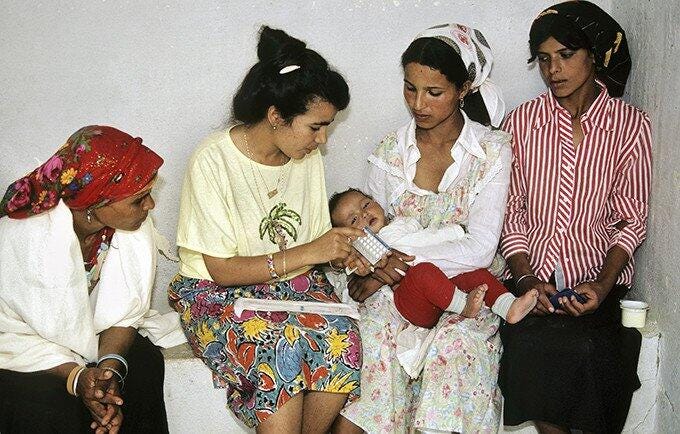
Figure 1. Isaac, John. Women learn about family planning at a clinic in Tunisia in 1987. 1987. Photograph. UN. https://eeca.unfpa.org/en/news/fifty-years-ago-it-became-official-family-planning-human-right
Recently, there has been a significant decrease in United States funding for foreign aid in tandem with the decision to end the United States Agency for International Development (USAID) program and its subsidiaries. One of the lesser discussed consequences of this move will have a drastic impact on the women and girls who compose nearly half of the developing world’s population.1
For the past several decades, across party lines and presidential administrations, the US provided funding for family planning services across the developing world. These services include providing family counseling, contraceptives, and treatment for sexually transmitted diseases. Largely through donations to providers, the US is responsible for $607.5 million annually in global funding for family planning services, comprising around 40% of global funding for family planning services and providing care for tens of millions of women worldwide. 47.6 million women receive contraceptive care alone as a result of US funding.2
These services, possible on the necessary scale only with US funding, are essential to the women and girls of developing nations. It’s not just the women and girls of developing nations who would be lost without these services. It’s also the economies - regional, national, and international. Historical studies find a direct link between the provision of contraceptives to girls and young women and earning potential and educational outcomes. Girls granted access to family planning services by the age of 18, on average, attain high school and post-secondary degrees at significantly higher rates and have much higher earning potential than girls without access to these services.
Educational attainment, gainful employment of women, and the ability to plan pregnancies in relation to family size and length of time between births have significant benefits. They are directly linked to not only better outcomes for mothers but also improved investment in children. Thus, they are also linked to improved educational outcomes and improved mental and behavioral development.3 These benefits directly result from the availability of family planning services. Without US funding, these services are not available on the necessary scale to women, girls, and families in developing nations.4
These services are essential to millions of people globally. $607.5 million of US funding for family planning serves 47.6 million women and couples across 41 developing nations. Annually this averts 34,000 maternal deaths by preventing 7.6 million unplanned births and 5.2 million unsafe abortions annually. It also leads to 17.1 million fewer unwanted pregnancies each year.5 However, a recent stop-work order from the Trump Administration froze all family planning funding, also excluding family planning services by name from the waiver issued permitting “life saving services” to continue.6 Despite their discontinuation, these services are essential. The 34,000 estimated maternal deaths averted by US funding every year will no longer be averted without these resources. This funding saves lives, yet is considered non-essential, as well as not providing “life saving services.”
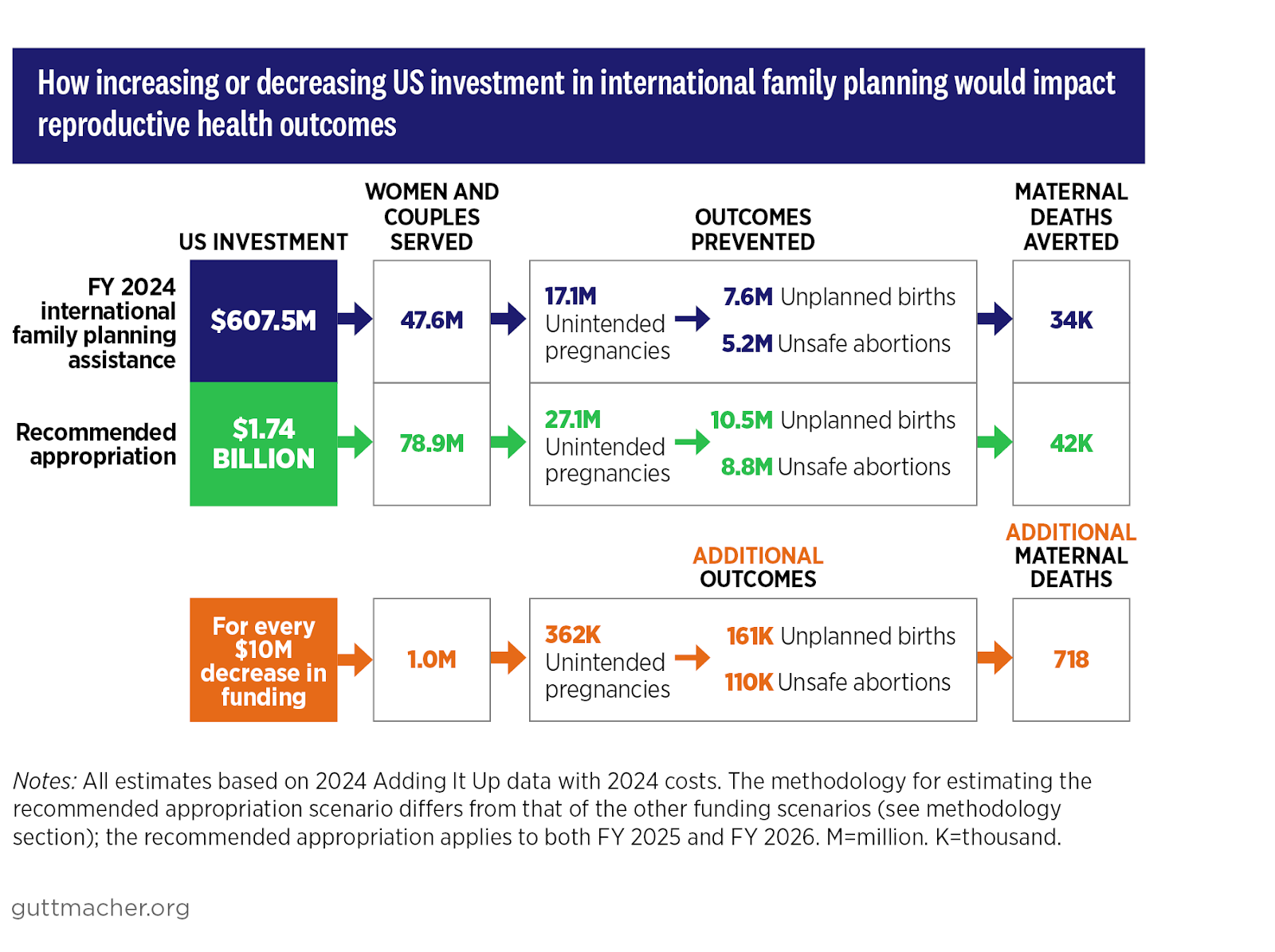
Figure 2. Damavandi, Samira, Elizabeth A. Sully, Amy Friedrich-Karnik, and Mira Tignor. How increasing or decreasing US investment in international family planning would impact reproductive health outcomes. (Guttmancher Institute, 2025) https://www.guttmacher.org/2025/02/just-numbers-impact-us-international-family-planning-assistance-2024
The additional 7.6 million unplanned births and 17.1 million unplanned pregnancies no longer averted through US funding will also have lifelong health implications for both the people giving birth and the children they give birth to. A study of 524,000 individuals found disastrous impacts of unplanned pregnancy and birth on both mothers and infants among pregnancies that reached full term.7 Unintended pregnancy is associated with higher rates of domestic violence, pre- and post-natal depression, and poorer maternal health behaviors. In infants, it is associated with pre-term birth, low birth rates, and delayed and/or insufficient care pre and post natal.8 By preventing these unplanned births and pregnancies, funding for family planning services improves maternal health outcomes and allows families and individuals to plan pregnancies for a time in which they are better able to care for children.
Abortion services made accessible by US funding are essential to women and girls in the 41 nations which receive US funding. These are pregnant individuals who would have sought out abortion regardless of the provider. But, with US funding, these individuals are able to receive safe, reliable abortions. US funding for contraceptive services prevents 5.2 million unsafe abortions from occurring annually. Safe abortions, defined as a WHO-approved method performed using the correct equipment by a trained professional, are provided as an alternative, protecting women and girls in developing nations and reducing one of the leading causes of maternal death. Unsafe abortion can result in life-long injuries and/or disability, heavy bleeding, infection, damage to internal organs, or loss of the ability to become pregnant in the future.9 Severe complications occur in around 1 in every 4 unsafe abortions.10 In comparison, safe abortions have a rate of complication (severe and minor) of only 2%. To the millions of women who will seek out abortion regardless of the provider, safe abortion as enabled by US funding is essential.
The contraceptives also funded by US assistance for family planning come largely in the form of barrier methods, birth control pills, implants, and emergency contraceptives. They prevent pregnancy, spread of Sexually Transmitted Diseases (STDs) and Sexually Transmitted Infections (STIs), as well as regulate hormonal cycles, among other purposes. In terms of STD and STI prevention, US-funded contraceptives are essential. Condoms prevent the spread of certain prevalent STDs and STIs such as HIV, HPV, and chlamidia by 98% when used correctly, compared to 89% when not used perfectly and 0% when not used at all.11 Condoms, along with other barrier methods such as dental dams and internal condoms, are essential in preventing the spread of STDs and STIs, especially in regions where treatment is not easily accessible.
Spread of STIs such as HIV/AIDS is prevalent in many developing countries due to the inaccessibility of treatment. In sub-Saharan Africa, as much as 47% of STDs are treated on a delayed timeline, making treatment more difficult and exacerbating long-term consequences.12 By preventing the spread of STDs in the first place, the number of individuals requiring treatment can be significantly reduced, thus making treatment more accessible to patients and easier to manage for providers.
Commonly prescribed forms of oral and implanted contraceptives (specifically pills, injection, implant, IUDs, and hormonal patches) are all over 90% effective when used typically and over 99% effective when used perfectly.13 This is in comparison to natural family planning (most commonly tracking hormonal cycles and extending breast feeding) and non-scientific methods such as withdrawal, which range from less than 50% to around 75% effective even when performed perfectly.14 An estimated 47.6 million women, girls, and couples rely on US funding specifically for their contraceptive care. As previously noted, US investment in global family planning services prevents 17.1 million unintended pregnancies each year, with an additional 362,000 unintended pregnancies prevented for every additional $10 million in US investment.15 In large part, this is due to the provision of contraceptives for the purpose of preventing unwanted pregnancy.
Without these contraceptives, there would be a much higher incidence of unwanted pregnancy, which has negative impacts on both the parent(s) and infant. Maternal consequences of unplanned pregnancy include higher rates of domestic violence and pre- and post-natal depression, as well as greater incidence of premature birth. For infants, unintended pregnancy is associated not only with lower weight at birth, but also insufficient and/or delayed pre and post natal care. Contraceptives, in slowing the spread of STDs and STIs and preventing unintended pregnancy, are essential to the wellbeing of entire communities and nations.
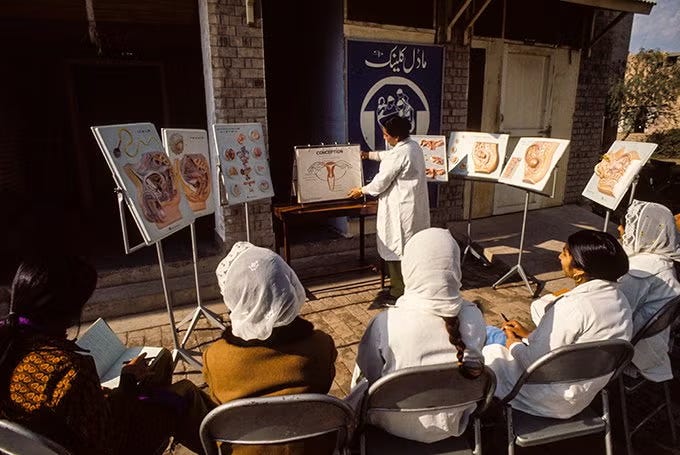
Wolf, B. Women attend a class in family planning in Pakistan in 1973. 1973. Photograph. UN.
https://eeca.unfpa.org/en/news/fifty-years-ago-it-became-official-family-planning-human-right
This is why cuts to family planning services will impact economies. The most straightforward way in which cuts to family planning services can hurt economies is a decrease in workforce. 95% of women in South Asia and 89% of women in sub-Saharan Africa are employed in informal sectors as a share of overall employment.16 Female employment in the informal labor market is integral to the economies of low and middle income countries.
When women are unable to exercise reproductive freedom, they are less able to participate in the workforce. Because unskilled jobs, which comprise 90% of the informal labor market are, so physically demanding, women and girls are unable to perform them in the later stages of pregnancy and post-partum.17 More than that, when women unexpectedly have a child and cannot access outside childcare, as is most often the case in such situations, they are unable to work. Mothers who cannot access outside childcare are forced to create their work schedule around childcare, making them less able to contribute to the economy.
When women cannot access contraceptive care and fall pregnant as a result, they cannot achieve gainful employment, often for several years. Thus, many of the 46.7 million women and couples serviced by US funding for family planning services will be unable to seek employment, nor contribute to their regional economies. Even at the most conservative estimates, the women experiencing the 7.6 million unplanned births and 5.2 million unsafe abortions annually averted by US funding will be unable to seek gainful employment as a result of their physical health and/or having to care for a child they are not financially equipped to plan for.
Further, when people are unable to work out of need to care for a child, they require assistance to support themself and their child. In most cases, the 7.6 million+ infants who were not planned for require outside assistance for food, household essentials, healthcare, clothing, and, of course, a caregiver. This requires programming from the government providing food, medical care, and subsidies to the primary caregiver for the infant, which adds up to billions of additional costs annually to nations that already struggle to provide such services. The financial costs of such programs to the governments of low and middle income nations would be disastrous.
Tax revenue will also be impacted as a result of the US cuts to funding for family planning services. Millions of unplanned children means millions of parents who are unable to seek employment while they provide necessary childcare. As a result, millions of individuals are no longer paying income taxes. With that said, personal income tax does not compose a significant percentage of tax revenue in lower income countries. Most low income countries garner around 10% of their tax revenue from personal income taxes, although the IMF believes that this percentage is set to increase, as it has nearly doubled in the past three decades.18 Lower income nations also tend to have lower tax rates, around 25-35% in most of sub-Saharan Africa and South Asia, compared to 40-50% in high income nations.19 Based on GDP, low income nations typically generate $5.6 billion a year in income tax revenue.20 This decrease in revenue is coupled with an increase in strain on assistance programs and greater need for revenue. As a result, decreases in family planning funding stand to create significant problems for the governments of low income nations.
It’s not just income taxes that will suffer as a result of cuts to family planning services - it’s also GDP. When women and girls experience unplanned pregnancy and birth, they are unable to complete the physical labor they are almost always employed in. As a result, they are unable to work, garner income, or contribute to GDP for extended periods of time following unplanned pregnancy and birth. And, as a result of losing millions of workers per annum, GDP also suffers. The informal market comprises 35% of GDP on average in low and middle income nations, and the percentage gets even higher among lower income nations. Given that able-bodied women comprise around 60% of the informal workforce (an exact number is difficult to estimate), this sector will be devastated by a significant reduction in workforce.21 This spells economic disaster for the 41 low and middle income nations reliant on US funding to provide family planning services to their citizens.
Referred to as recessions or, in more extreme cases, depressions, significant contractions in GDP are devastating to nations and entire regions. For individuals, loss in GDP means higher unemployment, lower wages, and dangerously high inflation, making it harder for people to provide for themselves and their families. Even moderate decreases in GDP have a direct correlation with worsened quality of life for individuals. For corporations, this means lower sales and, correspondingly, lower profits. This, in turn, leads to lower direct foreign investment in low and middle income countries, which slows the speed of development and thus worsens quality of life, inflation, and employment prospects for citizens of developing nations. Falling GDP creates a cycle of devastation that brings economic ruin to entire countries and populations.22
Cuts to family planning services are devastating on every level. They lead to much higher incidence of unplanned pregnancy and birth and STDs and STIs. More than that, they lead to higher levels of unsafe abortion, health complications for mothers and infants, and inaccessibility of treatment for STDs and STIs. In economic terms, cuts to family planning funding by the US will lead to a significant decrease in the informal labor force, greater strain on social welfare, and the potential for significant damage to GDP in low and middle income nations, 41 of which receive US funding for family planning services, with a total of 47.6 million women and couples served. All in all, there will be devastating impacts to this funding being terminated.
Works Cited
Works Cited
“Accelerating Sustainable Financing for Family Planning: Insights and Advocacy Recommendations Accelerating Sustainable Financing for Family Planning: Insights and Advocacy Recommendations.” Family Planning 2030, July 2025. https://www.fp2030.org/app/uploads/2025/07/Financing-impact-brief.pdf.
Barbuscia, Anna, Ariane Pailhé, and Anne Solaz. “Unplanned Births and Their Effects on Maternal Health: Findings from the Constances Cohort.” Social Science & Medicine 361 (November 2024): 117350. https://doi.org/10.1016/j.socscimed.2024.117350.
Benedek, Dora, Juan Carlos Benítez, and Charles Vellutini. “Personal Income Tax Has Untapped Potential in Poorer Countries.” IMF Blog, March 24, 2022. https://www.imf.org/en/blogs/articles/2022/03/24/personal-income-tax-has-untapped-potential-in-poorer-countries.
Brooks, Nina, Matt Gunther, Eran Bendavid, Elizabeth H. Boyle, Kathryn Grace, and Grant Miller. “U.S. Global Health Aid Policy and Family Planning in Sub-Saharan Africa.” Science Advances 9, no. 49 (2023): eadk2684. https://doi.org/10.1126/sciadv.adk2684.
Damavandi, Samira, Elizabeth A. Sully, Amy Friedrich-Karnik, and Mira Tignor. “Just the Numbers: The Impact of US International Family Planning Assistance, 2024.” Guttmacher Institute, February 2025. https://www.guttmacher.org/2025/02/just-numbers-impact-us-international-family-planning-assistance-2024.
Dassen, Santiago. “The Invisible Workforce: Women in the Informal Economy.” The Ludwig Institute for Shared Economic Prosperity, November 29, 2023. https://www.lisep.org/content/the-invisible-workforce-women-in-the-informal-economy.
Haddad, Lisa B., and Nawal M. Nour. “Unsafe Abortion: Unnecessary Maternal Mortality.” Reviews in Obstetrics & Gynecology 2, no. 2 (2009): 122–26.
Hayes, Adam. “Negative Growth: Definition and Economic Impact.” Investopedia, November 13, 2020. https://www.investopedia.com/terms/n/negative-growth.asp.
“How Well Contraception Works at Preventing Pregnancy.” National Health Service, January 31, 2024. https://www.nhs.uk/contraception/choosing-contraception/how-well-it-works-at-preventing-pregnancy/.
“List of Countries by Personal Income Tax Rate.” Trading Economics, 2019. https://tradingeconomics.com/country-list/personal-income-tax-rate.
Marfatia, Ys, Ipsa Pandya, and Kajal Mehta. “Condoms: Past, Present, and Future.” Indian Journal of Sexually Transmitted Diseases and AIDS 36, no. 2 (2015): 133. https://doi.org/10.4103/0253-7184.167135.
McKoy, Jilian P. “U.S. Policy on Global Aid Curtailed Family Planning Services in Africa.” Stanford University School of Medicine, December 6, 2023. https://healthpolicy.fsi.stanford.edu/news/us-policy-global-aid-curtailed-family-planning-services-africa.
MSI Reproductive Choices. “Unsafe Abortion: Consequences, Facts & Statistics.” October 1, 2022. https://www.msichoices.org/latest/unsafe-abortion-consequences-facts-statistics/.
“Natural Family Planning.” National Health Service, February 9, 2024. https://www.nhs.uk/contraception/methods-of-contraception/natural-family-planning/.
Nelson, Heidi D., Blair G. Darney, Katherine Ahrens, et al. “Associations of Unintended Pregnancy With Maternal and Infant Health Outcomes: A Systematic Review and Meta-Analysis.” JAMA 328, no. 17 (2022): 1714. https://doi.org/10.1001/jama.2022.19097.
Nolen, Stephanie. “Millions of Women Will Lose Access to Contraception as a Result of Trump Aid Cuts.” New York Times, April 1, 2025. https://www.nytimes.com/2025/04/01/health/usaid-contraception-cuts.html.
OECD. Breaking the Vicious Circles of Informal Employment and Low-Paying Work. OECD Publishing, 2024. https://doi.org/10.1787/f95c5a74-en.
“Over 1.4 Million Women and Girls in Africa Left Without Contraception as U.S. Orders Destruction of Global Supply.” International Planned Parenthood Foundation, August 6, 2025. https://www.ippf.org/media-center/over-14-million-women-and-girls-africa-left-without-contraception-us-orders.
“Population, Female (% of Total Population).” World Bank, 2024. https://data.worldbank.org/indicator/SP.POP.TOTL.FE.ZS.
Sonfield, Adam, Kinsey Hasstedt, Megan L. Kavanaugh, and Ragnar Anderson. “The Social and Economic Benefits of Women’s Ability to Determine Whether and When to Have Children.” Guttmacher Institute, 2013. https://www.guttmacher.org/sites/default/files/pdfs/pubs/social-economic-benefits.pdf.
Sully, Elizabeth A., Onikepe Owolabi, and Jessica D. Rosenburg. “Family Planning Impact of the Trump Foreign Assistance Freeze.” Guttmacher Institute, January 29, 2025. https://www.guttmacher.org/2025/01/family-planning-impact-trump-foreign-assistance-freeze.
“The Trump Administration’s Foreign Aid Review: Status of U.S. Family Planning and Reproductive Health Efforts.” Kaiser Family Foundation, July 23, 2025. https://www.kff.org/global-health-policy/the-trump-administrations-foreign-aid-review-status-of-u-s-family-planning-and-reproductive-health-efforts/.
“The U.S. Government and International Family Planning & Reproductive Health Efforts.” Kaiser Family Foundation, January 2, 2024. https://www.kff.org/global-health-policy/the-u-s-government-and-international-family-planning-reproductive-health-efforts/.
UN Women, United Nations Entity for Gender Equality and the Empowerment of Women, ed. Transforming Economies, Realizing Rights. Progress of the World’s Women 2015–2016. UN Women, 2015. https://www.unwomen.org/en/digital-library/publications/2015/4/progress-of-the-worlds-women-2015.
“Population, Female (% of Total Population),” World Bank, 2024, https://data.worldbank.org/indicator/SP.POP.TOTL.FE.ZS.
Sully, Elizabeth A., Onikepe Owolabi, and Jessica D. Rosenberg. “Family Planning Impact of the Trump Foreign Assistance Freeze.” Guttmacher Institute, January 29, 2025. https://www.guttmacher.org/2025/01/family-planning-impact-trump-foreign-assistance-freeze.
Nelson, Heidi D., Blair G. Darney, Katherine Ahrens, et al. “Associations of Unintended Pregnancy With Maternal and Infant Health Outcomes: A Systematic Review and Meta-Analysis.” JAMA 328, no. 17 (2022): 1714. https://doi.org/10.1001/jama.2022.19097.
Sully, Owolabi, Rosenberg, “Family Planning Impact of the Trump Foreign Assistance Freeze.”
Damavandi, Samira, Elizabeth A. Sully, Amy Friedrich-Karnik, and Mira Tignor. “Just the Numbers: The Impact of US International Family Planning Assistance, 2024.” Guttmacher Institute, February 2025. https://www.guttmacher.org/2025/02/just-numbers-impact-us-international-family-planning-assistance-2024.
“The Trump Administration’s Foreign Aid Review: Status of U.S. Family Planning and Reproductive Health Efforts.” Kaiser Family Foundation, July 23, 2025. https://www.kff.org/global-health-policy/the-trump-administrations-foreign-aid-review-status-of-u-s-family-planning-and-reproductive-health-efforts/.
Nelson et al., “Associations of Unintended Pregnancy With Maternal and Infant Health Outcomes.”
Barbuscia, Anna, Ariane Pailhé, and Anne Solaz. “Unplanned Births and Their Effects on Maternal Health: Findings from the Constances Cohort.” Social Science & Medicine 361 (November 2024): 117350. https://doi.org/10.1016/j.socscimed.2024.117350.
MSI Reproductive Choices. “Unsafe Abortion: Consequences, Facts & Statistics.” October 1, 2022. https://www.msichoices.org/latest/unsafe-abortion-consequences-facts-statistics/.
Haddad, Lisa B., and Nawal M. Nour. “Unsafe Abortion: Unnecessary Maternal Mortality.” Reviews in Obstetrics & Gynecology 2, no. 2 (2009): 122–26.
Marfatia, Y. S., Ipsa Pandya, and Kajal Mehta. 2015. “Condoms: Past, Present, and Future.” Indian Journal of Sexually Transmitted Diseases and AIDS 36 (2): 133–39. https://doi.org/10.4103/2589-0557.167135.
Chanie Agimas, Muluken, Milkias Solomon, Daniel Alayu Shewaye, Dessie Abebaw Angaw, and Nebiyu Mekonnen Derseh. 2024. “Prevalence of Delayed Treatment for Sexually Transmitted Infections and Its Determinants in Sub-Saharan Africa. A Systematic Review and Meta-Analysis.” PLOS One 19 (3): e0299629–29. https://doi.org/10.1371/journal.pone.0299629.
NHS. 2024. “How Well Contraception Works at Preventing Pregnancy.” Nhs.uk. February 29, 2024. https://www.nhs.uk/contraception/choosing-contraception/how-well-it-works-at-preventing-pregnancy/.
NHS. 2024 “Natural Family Planning.” Nhs.uk. February 29, 2024. https://www.nhs.uk/contraception/methods-of-contraception/natural-family-planning/.
Damavandi, Sully, Friedrich-Karnik, Tignor, “Impact of US International Family Planning Assistance, 2024”
UN Women. 2015. “Progress of the World’s Women 2015–2016: Transforming Economies, Realizing Rights.” UN Women. 2015. https://www.unwomen.org/en/digital-library/publications/2015/4/progress-of-the-worlds-women-2015.
Organization for Economic Cooperation and Development. 2024. “Breaking the Vicious Circles of Informal Employment and Low-Paying Work.” OECD.org. Organization for Economic Cooperation and Development. https://www.oecd.org/en/publications/breaking-the-vicious-circles-of-informal-employment-and-low-paying-work_f95c5a74-en.html#:~:text=Informal%20workers%20have%20few%20opportunities,vicious%2C%20intragenerational%20circle%20of%20informality.
Benedek, Dora, Juan Carlos Benitez, and Charles Vellutini. 2022. “Personal Income Tax Has Untapped Potential in Poorer Countries.” International Monetary Fund Blog, March 24, 2022. https://www.imf.org/en/Blogs/Articles/2022/03/24/personal-income-tax-has-untapped-potential-in-poorer-countries.
Trading Economics. 2019. “List of Countries by Personal Income Tax Rate.” Tradingeconomics.com. 2019. https://tradingeconomics.com/country-list/personal-income-tax-rate.
Bendek, Benitez, Vellutini, “Income Tax Potential in Poorer Countries”.
Dassen, Santiago. 2023. “The Invisible Workforce: Women in the Informal Economy.” The Ludwig Institute for Shared Economic Prosperity, November 29, 2023.
Hayes, Adam. 2020. “Negative Growth: Definition and Economic Impact.” Edited by Adam Kindness. Investopedia, November 13, 2020. https://www.investopedia.com/terms/n/negative-growth.asp.